Introduction: What Are AI Website Builders and Why Are They Gaining Popularity?
Creating a website has traditionally required technical skills, design knowledge, and considerable time investment. However, the rise of AI website builders is reshaping this landscape by automating many aspects of website creation. These tools leverage artificial intelligence to simplify and accelerate the process, making it accessible to entrepreneurs, small businesses, and content creators without specialized expertise.
AI website builders are gaining traction because they promise to reduce complexity, save costs, and deliver functional sites quickly. Understanding what these platforms are and how they operate can help you decide whether they fit your needs and expectations.
What Is an AI Website Builder?
An AI website builder is a software platform that uses artificial intelligence algorithms to assist users in designing, building, and launching websites. Unlike traditional drag-and-drop editors or template-based builders, AI website builders automate multiple steps, including:
- Design and layout: AI analyzes user preferences or inputs to generate visually coherent and user-friendly layouts tailored to the website’s purpose.
- Content generation: Some platforms provide AI-driven suggestions or drafts for text content such as headlines, product descriptions, or blog posts.
- SEO setup: AI tools can automatically configure meta tags, keywords, and other SEO essentials to improve search engine visibility.
- Functional recommendations: AI might suggest relevant features, plugins, or integrations based on the website’s goals.
In essence, an AI website builder bridges the gap between expertise and ease-of-use by embedding intelligent automation within the website creation workflow.
How AI Website Builders Work
The process of building a website with AI assistance generally unfolds in a series of steps, designed to minimize manual effort while maximizing customization possibilities.
User Input and Goal Definition
The journey typically starts with the user providing basic information, such as:
- Type of website (e.g., portfolio, online store, blog)
- Industry or niche
- Preferred style or branding elements (colors, fonts, tone)
- Key pages or features needed
This input helps the AI understand the context and desired outcomes.
AI-Powered Design Generation
Using the user’s input, the AI engine generates a tailored website design. This includes:
- Page layouts optimized for user experience
- Visual hierarchy and spacing
- Color schemes and typography that align with provided brand directions
The AI often creates multiple design drafts or variants for the user to review.
Automated Content Creation
Some AI builders incorporate natural language generation tools that produce textual content suggestions based on the website’s focus. This can include:
- About pages
- Product or service descriptions
- Blog posts or introductory paragraphs
Users can edit, accept, or replace this content to fit their voice.
Customization and Fine-Tuning
Despite AI automation, users retain control to customize the website further through intuitive interfaces such as drag-and-drop editors or settings panels. This step allows for personal touches and adjustments to align with exact preferences.
Publishing and Ongoing Optimization
Once satisfied, users can publish their site directly from the builder. Many AI website builders also offer ongoing analytics and SEO recommendations, enabling continuous improvement based on visitor data.
Key Features to Look For
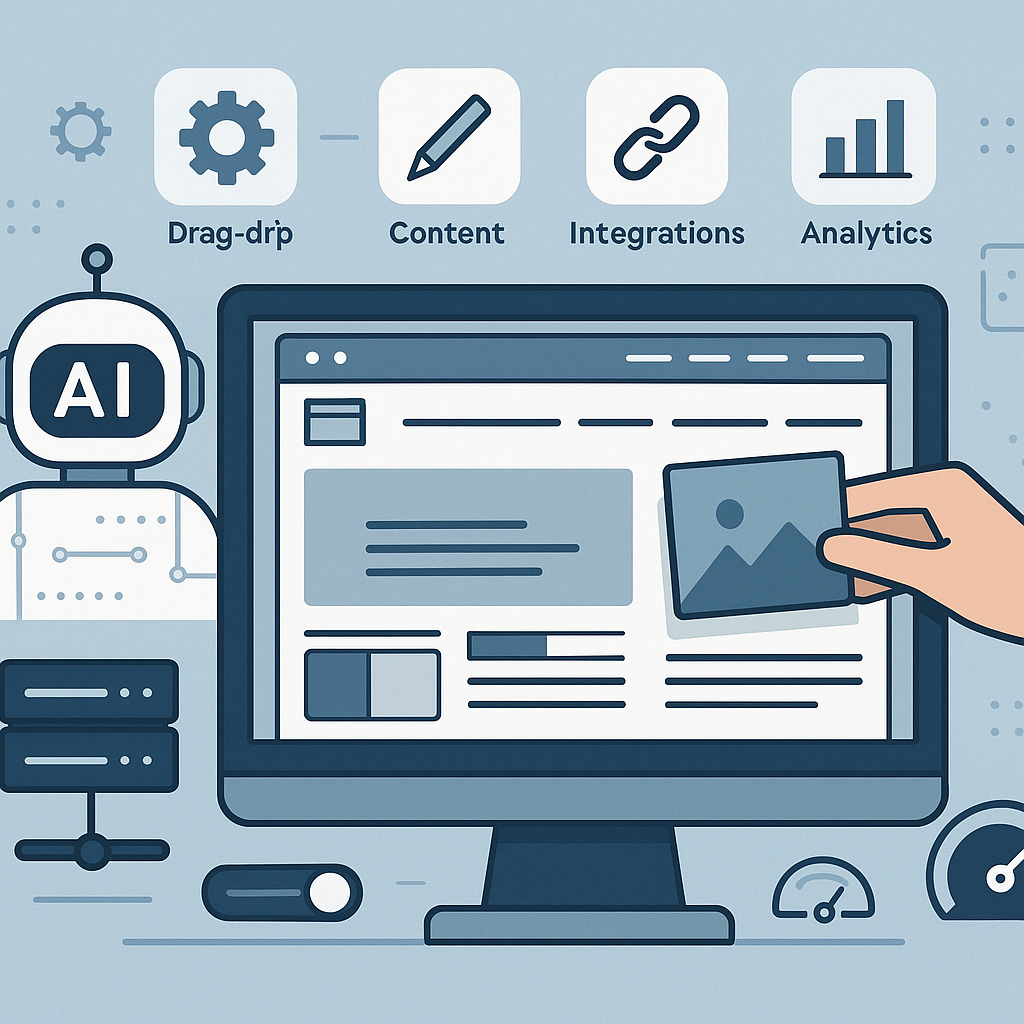
Drag-and-Drop Editing
Even with AI-generated designs, the ability to easily modify layouts and elements through drag-and-drop interfaces is essential for flexibility and personalization.
AI Content Generation
Look for platforms that offer AI-assisted text creation to speed up content development while providing editable drafts that reflect your brand’s tone.
SEO Tools
Effective SEO integration—including keyword suggestions, meta tag automation, and sitemap generation—helps ensure your site is discoverable on search engines without manual configuration.
Integrations
Support for third-party tools such as payment gateways, email marketing platforms, social media, and analytics services is crucial for expanding your site’s functionality.
Hosting
Many AI builders offer bundled hosting, simplifying deployment. Check for reliable uptime, speed, and security features included in the package.
Analytics
Built-in analytics dashboards enable you to track visitor behavior, traffic sources, and other performance metrics essential for data-driven improvements.
Benefits and Limitations
Benefits
- Speed: AI accelerates the website creation process, enabling launch within hours or even minutes.
- Cost savings: Reduces the need to hire professional designers or developers, lowering upfront expenses.
- Accessibility: Makes website creation approachable for those without technical or design expertise.
Limitations
- Customization constraints: AI-generated templates and structures can limit highly specific or advanced design needs.
- Dependence on AI outputs: Quality and originality of content and design depend on the AI’s training data and algorithms, which may not always align with unique brand identities.
- Learning curve: Some platforms require understanding new interfaces or AI workflows, which can be challenging initially.
Who Should Use an AI Website Builder?
AI website builders are a strong fit for:
- Entrepreneurs and startups seeking fast, affordable web presence without technical overhead.
- Small businesses aiming to establish or refresh websites with minimal time and resource investments.
- Bloggers and content creators who want to focus on content rather than web development intricacies.
- Freelancers and creatives needing portfolio sites built quickly to showcase their work.
However, businesses requiring highly customized, complex, or large-scale web solutions might find AI builders limiting and may prefer traditional development approaches.
Practical Checklist for Choosing an AI Website Builder
- Does the builder align with your website goals and industry? Ensure it supports your niche with relevant templates and features.
- How intuitive is the user interface? Evaluate ease of use through free trials or demos.
- What level of design and content customization is possible? Check if you can adjust AI-generated outputs to suit your brand voice.
- Are SEO and analytics tools comprehensive? Confirm the builder supports ongoing optimization efforts.
- Does it offer reliable hosting and security? Review performance benchmarks and included protections.
- What integrations are available? Assess compatibility with your existing marketing or sales tools.
- What is the pricing model? Understand costs, renewal fees, and any limitations on features or traffic.
By systematically assessing these factors, you can select an AI website builder that fits your requirements and empowers you to create an effective online presence efficiently.
![Understanding AI Website Builders: How They Work and Who Should Use Them [2026-05-29 11:58:17 1bv161]](https://getwpai.com/wp-content/uploads/2026/05/getwpai-20260529-115817.png)
![Mastering AI-Powered Content Automation in WordPress: A Strategic Guide for Scalable Growth [2026-05-25 11:43:01 rdw72k]](https://getwpai.com/wp-content/uploads/2026/05/getwpai-20260525-114301.png)