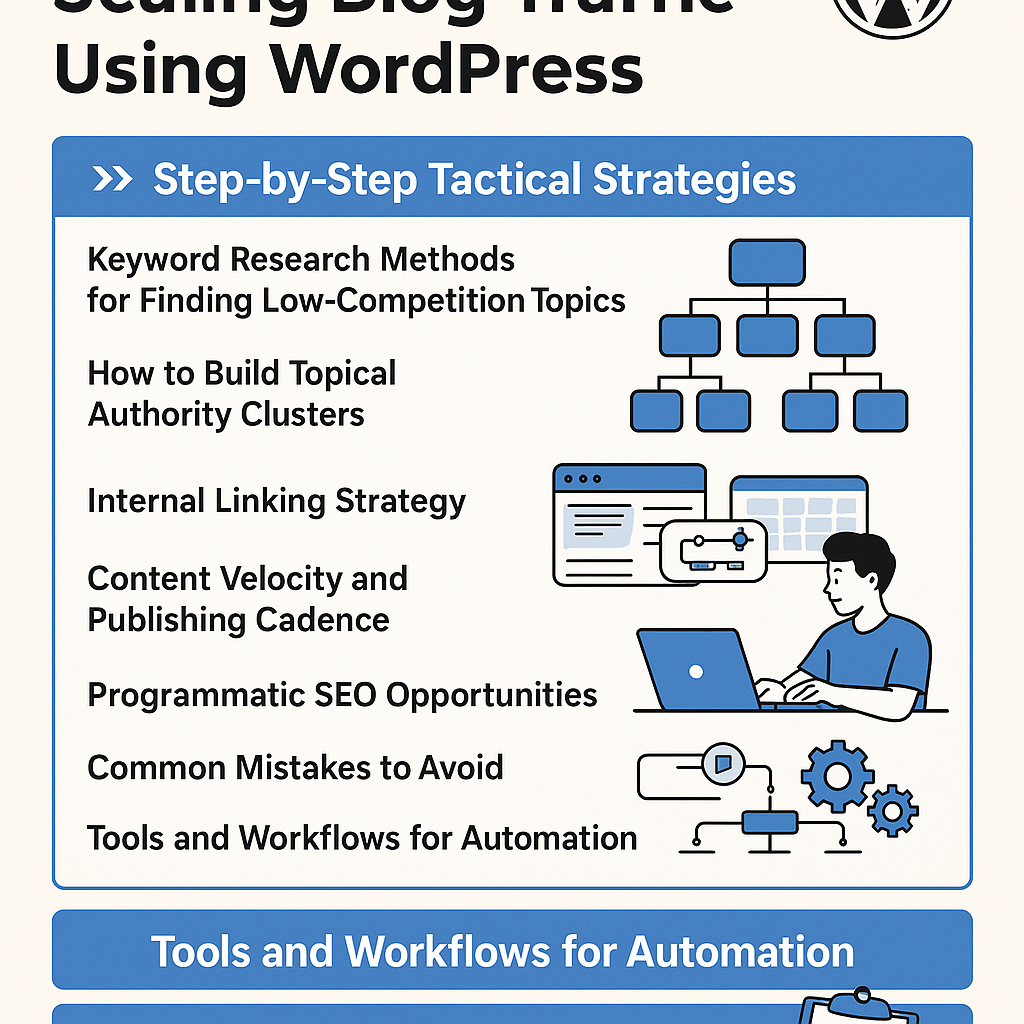
Introduction
Growing blog traffic on WordPress requires more than generic advice. It demands tactical execution supported by data, automation, and a clear content strategy. This guide focuses exclusively on advanced, actionable methods to scale your organic traffic sustainably, emphasizing automation and programmatic techniques without the typical hype.
Step 1: Precision Keyword Research for Low-Competition Topics
Targeting low-competition keywords is the foundation of scaling traffic efficiently. Here’s a step-by-step approach:
Use Niche-Specific Seed Keywords
Start with a small set of precise seed keywords relevant to your niche. For example, a SaaS company specializing in project management might use “Kanban board software” or “agile workflow tools.”
Leverage Advanced Keyword Tools
Use tools like Ahrefs, SEMrush, or Keyword Cupid that allow filtering by Keyword Difficulty (KD). Set a KD threshold (usually below 20) to surface low-competition long-tail keywords.
Analyze SERP Features and Competitors
Manually review top-ranking pages for these keywords. If most results are weak blogs or forums, this signals a viable opportunity.
Example Tactical Workflow
- Enter seed keywords into Ahrefs Keyword Explorer.
- Filter results by KD < 20 and search volume > 300.
- Export keywords and cluster based on semantic similarity.
- Prioritize clusters with clear user intent and manageable competition.
Step 2: Building Topical Authority Clusters
Topical clusters group related content to establish authority on specific themes, improving rankings for broad keywords.
Create a Pillar Page
Develop an in-depth, cornerstone article that broadly covers your niche topic. For example, “The Ultimate Guide to Agile Project Management Tools.”
Develop Cluster Content
Write multiple supporting posts targeting specific facets or subtopics, such as “Best Kanban Board Features” or “How Agile Tools Improve Team Productivity.”
Link Strategically Within the Cluster
Each cluster article should link back to the pillar page and to other cluster pages where relevant, reinforcing semantic relevance.
Step 3: Internal Linking Strategy for SEO and UX
Internal linking transfers page authority and improves crawlability, enhancing your SEO footprint.
Use Descriptive Anchor Texts
Choose anchor texts that accurately describe the linked page’s content to help search engines understand context.
Implement a Hub-and-Spoke Structure
Position your pillar pages as hubs that link out to detailed cluster pages (spokes), and cluster pages link back, creating a dense network.
Automate Internal Linking
Utilize WordPress plugins like Internal Link Juicer or Link Whisper to automatically suggest and insert relevant internal links based on keyword targets, saving time and maintaining consistency.
Step 4: Content Velocity and Publishing Cadence
Consistent and frequent publishing signals authority and freshness to search engines.
Set Realistic Publishing Goals
Analyze your capacity and aim for a minimum of 2–3 quality posts per week to maintain momentum without sacrificing quality.
Batch Content Creation
Use editorial calendar tools like CoSchedule or WordPress Editorial Calendar to plan and batch write content, optimizing workflow.
Measure Impact and Adjust
Track traffic and keyword rankings weekly to identify the optimal cadence and topics to double down on.
Step 5: Programmatic SEO Opportunities
Programmatic SEO uses automation to create large volumes of content targeting long-tail keywords, ideal for scalable traffic growth.
Identify Data-Rich Content Niches
Examples include directories, product comparisons, or location-specific content where data can be templated.
Use WordPress Custom Post Types and Templates
Create custom post types to structure programmatic content, then use dynamic templates to generate pages automatically.
Example: SaaS Feature Comparison Pages
- Compile a database of SaaS tools and features.
- Programmatically generate comparison pages for each feature combination.
- Optimize each page with unique meta data and internal linking.
Automation Tools
Leverage tools like WP All Import for bulk data import and Advanced Custom Fields (ACF) for flexible content structures.
Step 6: Common Mistakes to Avoid
- Overloading on Generic Keywords: Avoid targeting overly broad keywords with fierce competition.
- Neglecting Internal Linking: Failing to create a logical link structure dilutes SEO benefits.
- Publishing Without Strategy: Random posting without thematic focus wastes effort.
- Ignoring User Intent: Content should satisfy the specific needs behind the keywords.
- Over-automation Without Quality Control: Automated content still requires human review to maintain standards.
Step 7: Tools and Workflows for Automation
Keyword Research & Clustering
- Ahrefs or SEMrush for keyword discovery and difficulty analysis.
- Keyword Cupid for clustering similar keywords.
Content Management & Scheduling
- WordPress Editorial Calendar plugin for scheduling.
- CoSchedule for team collaboration and workflow automation.
Internal Linking Automation
- Link Whisper to auto-suggest and insert internal links based on keyword targets.
Programmatic Content Generation
- WP All Import to bulk upload datasets.
- Advanced Custom Fields for creating dynamic templates.
Quality Assurance
- Grammarly or Hemingway Editor for content clarity and grammar.
Practical Implementation Checklist
- Conduct low-competition keyword research with clear KD filters.
- Cluster keywords and create pillar plus cluster content.
- Implement a hub-and-spoke internal linking structure.
- Set and maintain a consistent publishing schedule (2–3 posts/week minimum).
- Identify programmatic SEO opportunities with templated data.
- Automate internal linking using WordPress plugins.
- Use custom post types and dynamic templates for scalable content.
- Continuously monitor rankings and traffic to iterate your strategy.
- Avoid generic keywords and unfocused content creation.
- Incorporate automated tools but enforce human quality checks.
By applying these advanced, tactical strategies within your WordPress environment, you can build a scalable, data-driven blog traffic growth engine that leverages automation smartly without compromising quality or relevance.
![Understanding AI Website Builders: How They Work and Who Should Use Them [2026-05-29 11:58:17 1bv161]](https://getwpai.com/wp-content/uploads/2026/05/getwpai-20260529-115817.png)
![Mastering AI-Powered Content Automation in WordPress: A Strategic Guide for Scalable Growth [2026-05-25 11:43:01 rdw72k]](https://getwpai.com/wp-content/uploads/2026/05/getwpai-20260525-114301.png)