Introduction
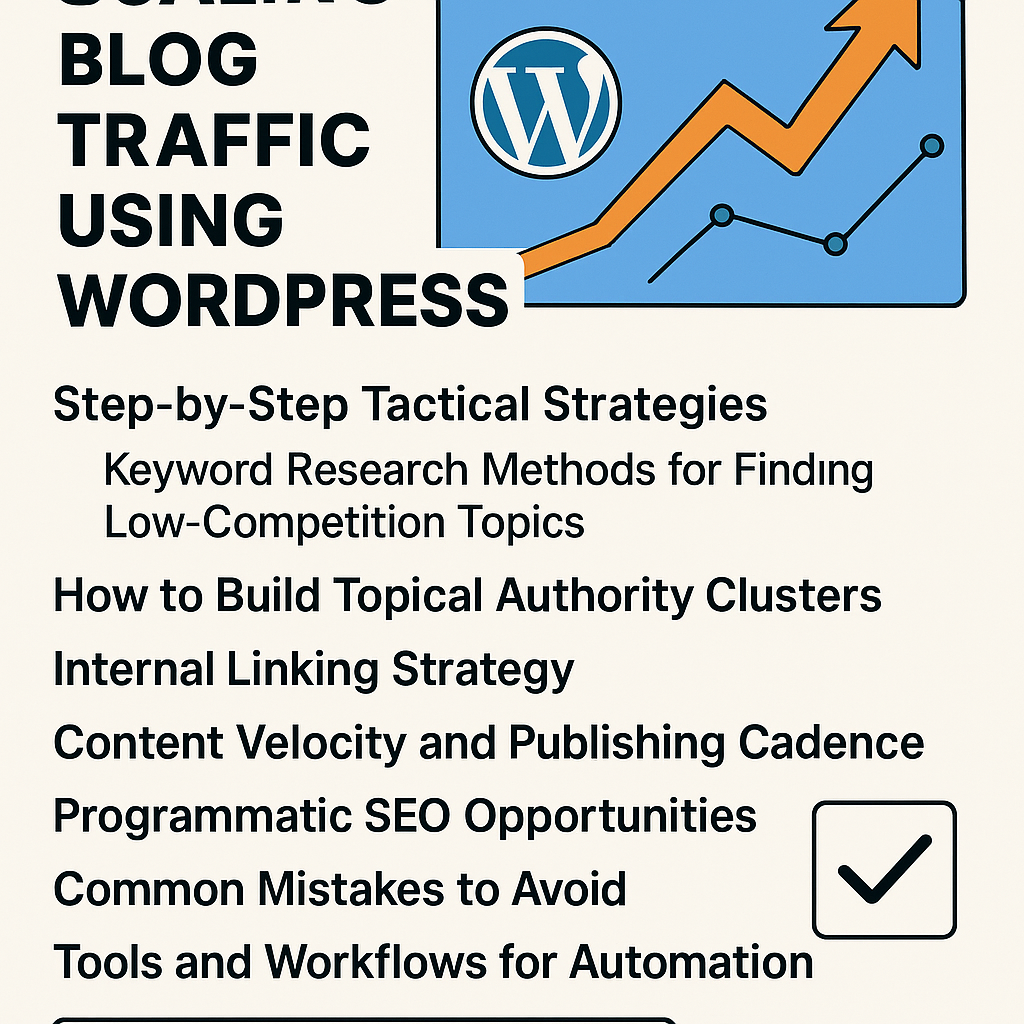
Scaling organic traffic on a WordPress blog requires more than just publishing frequently or chasing generic SEO tips. Serious site owners, affiliate marketers, SaaS founders, and agencies must apply precise, tactical strategies to build topical authority, optimize internal linking, and leverage automation for scalable growth. This post dives deep into advanced, actionable methods that go beyond fluff, focusing on data-driven keyword research, content clusters, programmatic SEO, and workflow automation to take your traffic to the next level.
1. Tactical Keyword Research: Finding Low-Competition, High-ROI Topics
Most SEO mistakes start with poor keyword selection. To find low-competition keywords that can quickly boost traffic:
Step 1: Use Multiple Tools for Cross-Validation
- Ahrefs/SEMrush: Identify keywords with a Keyword Difficulty (KD) below 20 that have decent search volume (100-500 monthly searches) and align with your niche.
- Google Search Console (GSC): Export queries that already bring impressions but low clicks. These often indicate low-hanging fruit where you can improve rankings.
- AnswerThePublic/BuzzSumo: Find question-based keywords and trending topics you can target with targeted content.
Step 2: Analyze SERP Features and Competitor Content
- Check if the SERP is dominated by authoritative sites or if there is room for your blog.
- Look for content gaps such as outdated posts or thin coverage you can improve.
Actionable Example:
If you run a SaaS blog about productivity, a keyword like “best time tracking tools for freelancers” might have moderate search volume but low competition if current results are mostly generic listicles without detailed comparison.
2. Building Topical Authority Clusters on WordPress
Google rewards sites that demonstrate comprehensive expertise on a subject. A topical authority cluster is a group of interlinked posts covering related subtopics in depth.
Step 1: Define Your Pillar Topics
Identify 3-5 broad themes central to your niche. For example, a WordPress affiliate marketer might pick: WordPress Hosting, Theme Customization, SEO Plugins, Website Speed Optimization.
Step 2: Create Cluster Content
- Each cluster should have 8-15 supporting articles targeting long-tail keywords related to the pillar.
- Example: Under “SEO Plugins,” write posts like “How to Configure Yoast SEO for Beginners,” “Rank Math vs Yoast: Which is Better?” and “Advanced Schema Markup with SEO Plugins.”
Step 3: Use WordPress Categories and Tags Strategically
Assign cluster posts to relevant categories and tags that align with your pillar topics, enabling structured navigation and semantic relevance.
3. Internal Linking Strategy for Maximum SEO Impact
Internal links distribute link equity and help Google understand content relationships.
Step 1: Link from Cluster Posts to Pillar Pages
Every cluster article should include contextual links back to its pillar page using keyword-rich anchor text.
Step 2: Cross-Link Cluster Posts When Relevant
Interlink related cluster articles to build a dense web of relevant content.
Step 3: Limit Outbound Internal Links Per Page
Keep internal links per page under 50 to avoid diluting link value and confusing crawlers.
WordPress Implementation Tip:
Use plugins like Yoast SEO internal linking suggestions or Rank Math to automate link recommendations during editing.
4. Content Velocity and Publishing Cadence
Consistent publishing signals to search engines that your site is active and authoritative.
Step 1: Establish a Realistic Publishing Schedule
Start with 2-3 posts weekly focusing on quality over quantity. Scale up only if you have resources to maintain editorial standards.
Step 2: Prioritize Content Types
- Cluster Content: Regularly add supporting cluster articles.
- Pillar Updates: Refresh pillar pages quarterly with new insights and updated links.
Step 3: Use Editorial Calendars
Tools like Edit Flow or WordPress’s built-in calendar help visualize and plan publishing cadence.
5. Leveraging Programmatic SEO Opportunities
Programmatic SEO automates the creation of large volumes of similar content pages optimized for search.
Step 1: Identify Scalable Content Types
Examples include:
- Location-based landing pages (e.g., “Best WordPress Developers in [City]”)
- Product comparison tables with dynamic filters
- FAQ pages generated from structured datasets
Step 2: Use WordPress Custom Post Types and Templates
Create templates that dynamically populate page content based on metadata or external databases.
Step 3: Automate Content Generation with AI Carefully
Use AI tools to generate initial drafts or data-driven content snippets but always review for accuracy and uniqueness to avoid thin content penalties.
6. Common Mistakes to Avoid When Scaling Traffic
- Chasing High Volume Keywords Exclusively: Ignoring low-competition, niche keywords leads to slow growth.
- Neglecting Internal Linking: Missing chances to reinforce topical clusters reduces SEO impact.
- Publishing Without Strategy: Random posting dilutes authority and confuses search engines.
- Overusing Automation Without Oversight: Poorly monitored AI-generated content can harm rankings.
- Ignoring Page Speed and Mobile Experience: Technical SEO issues can negate content efforts.
7. Tools and Workflows to Automate and Scale
Keyword Research and Monitoring
- Ahrefs/Semrush API: Automate keyword tracking and SERP position reporting.
- Google Search Console API: Extract data on queries and clicks regularly for content ideation.
Content Planning and Publishing
- Editorial Calendar Plugins: Use Edit Flow or CoSchedule for scheduling and collaboration.
- WordPress REST API + Custom Scripts: Automate bulk post creation or updates for programmatic SEO pages.
Internal Linking Automation
- Plugins like Link Whisper provide automated internal link suggestions and reporting.
Content Generation
- Use AI tools (OpenAI, Jasper) for drafting but integrate human review workflows.
Workflow Example:
1. Export low-competition keywords weekly from Ahrefs.
2. Assign keywords to writers via editorial calendar.
3. Use Link Whisper to add internal links pre-publish.
4. Publish and monitor performance via GSC API.
5. Update pillar pages quarterly with cluster content insights.
Implementation Checklist for Scaling WordPress Blog Traffic
- Conduct multi-tool keyword research focusing on low KD, moderate volume keywords.
- Define 3-5 pillar topics and build supporting content clusters.
- Implement strategic internal linking: cluster to pillar + cross-linking.
- Set and maintain a consistent publishing cadence (2-3 quality posts/week minimum).
- Identify programmatic SEO opportunities and build templates with custom post types.
- Automate keyword tracking and internal linking suggestions using plugins and APIs.
- Integrate AI for content drafting with strict editorial review processes.
- Regularly update pillar pages and prune outdated content.
- Monitor site speed and mobile usability to avoid technical SEO issues.
- Track progress with GSC and analytics, then iterate based on data.
Applying these advanced, tactical strategies with discipline and automation will enable serious WordPress site owners to scale organic traffic sustainably and efficiently, turning their blogs into authoritative niche assets.
![Understanding AI Website Builders: How They Work and Who Should Use Them [2026-05-29 11:58:17 1bv161]](https://getwpai.com/wp-content/uploads/2026/05/getwpai-20260529-115817.png)
![Mastering AI-Powered Content Automation in WordPress: A Strategic Guide for Scalable Growth [2026-05-25 11:43:01 rdw72k]](https://getwpai.com/wp-content/uploads/2026/05/getwpai-20260525-114301.png)