Introduction
Growing a WordPress blog’s organic traffic beyond initial milestones requires more than basic SEO tweaks. It demands a strategic, data-driven approach combining targeted keyword research, content architecture, and scalable automation. This article breaks down advanced, step-by-step tactics for scaling blog traffic effectively, avoiding common pitfalls, and maximizing your time and resources.
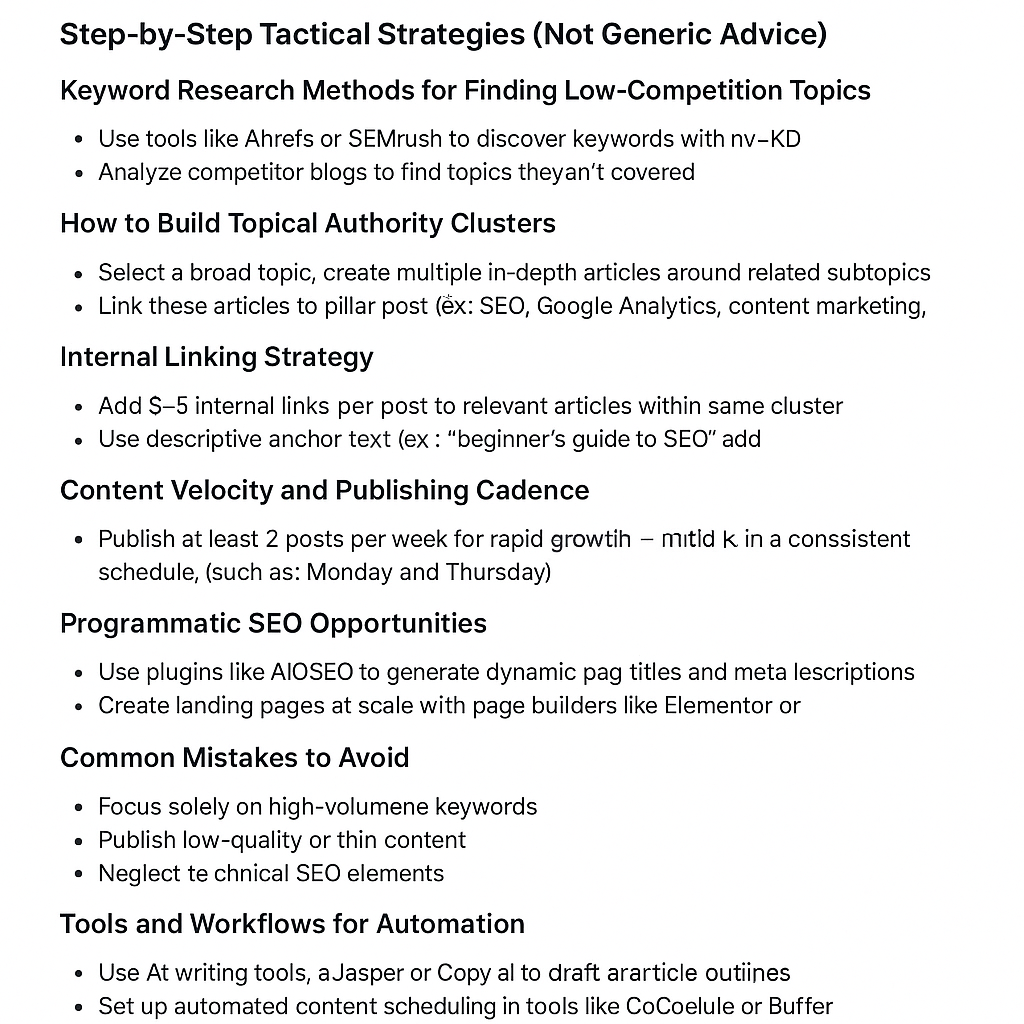
1. Tactical Keyword Research: Finding Low-Competition Gems
Many site owners waste effort chasing broad, competitive keywords. Instead, focus on precise, low-competition keywords with clear intent. Here’s how:
Step-by-step process:
- Start with Seed Topics: Use your niche’s core themes as a base.
- Leverage Keyword Tools: Use tools like Ahrefs, SEMrush, or Ubersuggest to extract long-tail variations and questions.
- Analyze Keyword Difficulty (KD): Filter for keywords with KD < 20 for higher chances of ranking.
- Check SERP Features: Prioritize keywords featuring featured snippets, People Also Ask, or video results to capture diverse traffic.
- Evaluate Search Intent: Ensure the keyword aligns with content you can produce that satisfies users (informational, transactional, etc.).
Example: Instead of targeting “WordPress SEO,” narrow down to “optimize WordPress SEO for local businesses”—a more specific, lower-competition phrase with actionable intent.
2. Building Topical Authority Clusters
Google rewards sites that demonstrate topical depth and breadth. Creating a cluster model around core topics signals expertise.
How to build clusters:
- Main Pillar Page: Create a comprehensive, authoritative page covering broad aspects of your main topic.
- Supporting Cluster Posts: Publish detailed posts on subtopics linked back to the pillar page.
- Consistent Internal Linking: Use contextual anchors linking cluster posts to the pillar and vice versa.
Example: For a SaaS blog, a pillar page on “Email Automation Best Practices” can link out to cluster posts like “Segmenting Email Lists in WordPress” and “Using AI to Personalize Email Campaigns.”
3. Strategic Internal Linking for SEO and UX
Internal linking is a powerful, often underutilized lever for passing link equity and improving crawlability.
Effective internal linking tactics:
- Use Descriptive Anchor Text: Avoid generic “click here” links; use keyword-rich phrases.
- Link Deep: Don’t just link to homepage or top-level pages; link to relevant deep cluster content.
- Maintain Reasonable Link Volume: Keep internal links per page between 3-10 to avoid dilution.
- Audit Regularly: Use tools like Screaming Frog or Ahrefs to find orphan pages and broken internal links.
4. Optimizing Content Velocity and Publishing Cadence
Content velocity—the speed and frequency of publishing—affects crawl budget and topical authority.
Practical guidelines:
- Consistency Over Volume: Publish a steady stream of quality posts (e.g., 2-3 posts weekly) rather than sporadic bursts.
- Batch Content Creation: Plan and write content in batches to maintain momentum.
- Repurpose High-Performing Content: Update and expand existing posts to maintain freshness without reinventing the wheel.
Example: Use editorial calendars and tools like Trello or Asana to schedule and track publishing cadence aligned with keyword clusters.
5. Programmatic SEO: Scaling Content with Precision
Programmatic SEO involves generating large volumes of hyper-relevant pages by combining templates with dynamic data.
How to implement programmatic SEO on WordPress:
- Identify Suitable Topics: Use data-driven niches with scalable parameters (e.g., local business listings, product comparisons).
- Prepare Data Sets: Collect structured data like locations, product specs, or service features.
- Build Dynamic Templates: Use custom post types and Advanced Custom Fields (ACF) to automate page creation.
- Integrate Automation Tools: Utilize WP All Import, Zapier, or custom scripts to feed data into templates.
Example: A site targeting local SEO could programmatically create pages like “Best Plumbers in [City]” dynamically populated with reviews, addresses, and service details.
6. Common Mistakes to Avoid
- Ignoring Search Intent: Writing content that doesn’t satisfy user queries leads to high bounce rates.
- Overloading Internal Links: Excessive or irrelevant links dilute SEO value and confuse users.
- Publishing Without Strategy: Random topics and inconsistent posting hinder topical authority.
- Neglecting Technical SEO: Slow site speed, poor mobile experience, and crawl errors undermine traffic growth.
- Over-reliance on Automation Without Quality Control: Programmatic pages must maintain relevance and uniqueness to avoid penalties.
7. Tools and Workflow Automation for Scale
Automation streamlines repetitive tasks and enables scaling without sacrificing quality.
Recommended tools and workflows:
- Keyword Research: Ahrefs API + Google Sheets integration for automated keyword filtering and tracking.
- Content Planning: Editorial calendar plugins like Edit Flow combined with Trello for team coordination.
- Programmatic Content Generation: WP All Import + ACF + Custom PHP scripts to auto-generate posts from CSV datasets.
- Internal Linking: Link Whisper plugin for automated and optimized internal linking suggestions.
- Performance Monitoring: Google Search Console automated alerts + SEMrush position tracking for spotting issues early.
Implementing these tools in a consistent, repeatable workflow accelerates traffic growth while maintaining control.
Implementation Checklist
- Conduct targeted keyword research focusing on low-competition, high-intent phrases.
- Develop pillar pages with supporting cluster content linked strategically.
- Audit and optimize internal linking with descriptive anchors and balanced link distribution.
- Maintain a consistent publishing schedule using batch content creation methods.
- Identify scalable niches suitable for programmatic SEO and set up dynamic templates.
- Avoid common pitfalls like ignoring intent and over-automation without oversight.
- Leverage automation tools for keyword research, content planning, internal linking, and monitoring.
- Regularly review site performance and update strategies based on data.
By integrating these advanced, actionable strategies into your WordPress blog growth plan, you position your site not just to attract traffic but to sustain and scale it strategically over time.
![Understanding AI Website Builders: How They Work and Who Should Use Them [2026-05-29 11:58:17 1bv161]](https://getwpai.com/wp-content/uploads/2026/05/getwpai-20260529-115817.png)
![Mastering AI-Powered Content Automation in WordPress: A Strategic Guide for Scalable Growth [2026-05-25 11:43:01 rdw72k]](https://getwpai.com/wp-content/uploads/2026/05/getwpai-20260525-114301.png)