Introduction
In recent years, AI website builders have emerged as an innovative solution for creating websites quickly and with minimal technical expertise. By harnessing artificial intelligence, these platforms streamline the traditionally complex process of website development, making it accessible to a broader audience. Their rise in popularity stems from the increasing demand for efficient, cost-effective tools that simplify launching an online presence.
What Is an AI Website Builder?
An AI website builder is a digital tool that leverages artificial intelligence algorithms to automate key aspects of website creation. Unlike conventional website builders that rely heavily on manual design and coding, AI website builders handle multiple tasks automatically, including design layout, content generation, and even search engine optimization (SEO) setup. This automation allows users to develop functional, visually appealing websites without needing in-depth web development or design skills.
At its core, an AI website builder uses data input from the user and applies machine learning models to generate tailored website elements. It can suggest layouts, color schemes, and typography based on the desired style or industry. Additionally, it can create relevant text content and optimize metadata to improve search engine rankings.
How AI Website Builders Work
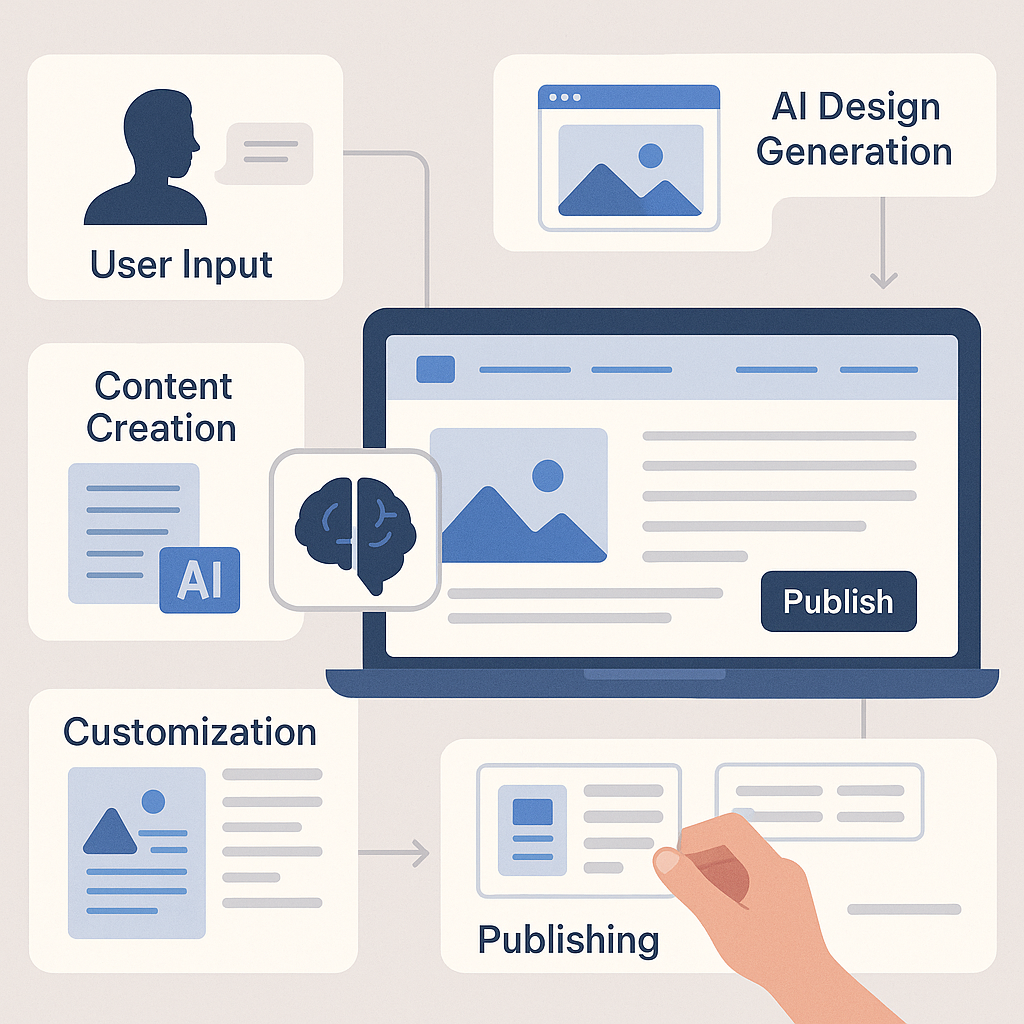
The process of building a website with AI can generally be broken down into several key steps:
User Input
The journey begins with the user providing essential information about their website goals. This often includes the type of business or project, preferred design style, key features needed, and sometimes target audience details. This input forms the foundation for the AI’s customization.
AI-Driven Design Generation
Based on the user’s input, the AI analyzes patterns from vast datasets of successful website designs and generates a tailored layout. This includes positioning navigation menus, headers, images, and calls to action in a way that aims to maximize user engagement and usability.
Content Creation
Some AI website builders offer content generation capabilities. Using natural language processing, the AI writes or suggests text for various pages such as home, about, services, and contact. This feature can dramatically reduce the time taken to populate a website with meaningful content.
Customization
Although the AI provides an initial website draft, users typically have the option to refine and personalize the design and content. Tools like drag-and-drop editors enable adjustments to layout, colors, images, and text to better align with the user’s vision.
Publishing
Once the user finalizes the design and content, the AI website builder usually supports direct publishing to the web, often including hosting services. Some platforms also automate SEO setup and generate analytics dashboards to monitor site performance post-launch.
Key Features to Look For
Drag-and-Drop Editing
While AI handles much of the initial work, a user-friendly drag-and-drop editor is crucial for manual customization. This feature empowers users to tweak layouts and elements without coding.
AI Content Generation
Look for tools that can assist with creating or suggesting website copy. This can be especially valuable for users who struggle with writing or want to speed up development.
SEO Tools
Effective AI website builders include built-in SEO functionalities such as metadata optimization, keyword suggestions, and sitemap generation to help improve search engine visibility.
Integrations
Compatibility with third-party services like email marketing platforms, payment gateways, and social media enhances a website’s functionality and reach.
Hosting
Many AI website builders provide integrated hosting, simplifying the publishing process. It’s important to confirm hosting reliability, speed, and security features.
Analytics
Access to traffic and user behavior analytics helps users understand website performance and make informed improvements over time.
Benefits and Limitations
Benefits:
- Speed: AI automates time-consuming tasks, enabling rapid website creation.
- Cost Savings: Reduces or eliminates the need to hire professional designers and developers.
- Accessibility: Makes website building approachable for individuals without technical backgrounds.
Limitations:
- Customization Constraints: AI-generated templates may restrict unique design choices, leading to similarities across sites.
- Dependency on AI: Over-reliance on AI can limit creative control and may result in generic content.
- Complex Projects: AI builders may struggle to accommodate highly specialized or complex website requirements.
Who Should Use an AI Website Builder?
AI website builders are particularly well-suited for:
- Entrepreneurs and Startups: Those needing a professional website quickly to establish an online presence.
- Small Businesses: Owners seeking cost-effective ways to showcase products and services without extensive technical investment.
- Bloggers and Content Creators: Individuals wanting to launch personal or niche websites with minimal hassle.
- Freelancers and Creators: Professionals who require simple portfolios or landing pages to display their work.
However, businesses requiring highly customized, complex websites might find AI builders less flexible compared to traditional development methods.
Practical Checklist for Choosing an AI Website Builder
- Ease of Use: Is the interface intuitive for non-technical users?
- Customization Options: Does it allow sufficient control over design and content?
- Content Quality: Are AI-generated texts relevant and well-written?
- SEO Features: Are there tools to optimize your site for search engines?
- Integration Capabilities: Can it connect with essential third-party services?
- Hosting Reliability: Is hosting included, and what are the uptime guarantees?
- Analytics Access: Does it provide insights into visitor behavior and site performance?
- Support and Resources: Is customer support responsive and are tutorials available?
By carefully evaluating these factors, you can select an AI website builder that matches your needs and helps you launch your online presence effectively.
![Understanding AI Website Builders: How They Work and Who Should Use Them [2026-05-29 11:58:17 1bv161]](https://getwpai.com/wp-content/uploads/2026/05/getwpai-20260529-115817.png)
![Mastering AI-Powered Content Automation in WordPress: A Strategic Guide for Scalable Growth [2026-05-25 11:43:01 rdw72k]](https://getwpai.com/wp-content/uploads/2026/05/getwpai-20260525-114301.png)