Introduction: Defining AI Website Builders and Their Rise
In recent years, the process of creating websites has become more accessible and efficient thanks to advances in artificial intelligence (AI). AI website builders are platforms that use AI algorithms to automate many aspects of website creation, from design and layout to content generation and search engine optimization (SEO). These tools are gaining popularity because they promise to reduce the technical barrier and time involved in launching a website, making them attractive to entrepreneurs, small business owners, bloggers, and creators seeking streamlined web presence solutions.
What Is an AI Website Builder?
At its core, an AI website builder is software that leverages artificial intelligence to automate traditionally manual tasks involved in building a website. Unlike conventional website builders where users select templates and customize elements manually, AI website builders analyze user input and preferences to generate tailored designs and content automatically.
This automation typically covers several key areas:
- Design and Layout: AI algorithms select color schemes, typography, and layout structures based on the user’s industry, goals, and style preferences.
- Content Generation: Some AI builders can create written content such as headlines, product descriptions, or blog posts by interpreting user prompts or business information.
- SEO Setup: Automated SEO configurations help improve search engine visibility by suggesting keywords, generating meta tags, and structuring pages for optimized indexing.
By integrating these elements, AI website builders aim to simplify and accelerate the website creation process while producing professional-looking results.
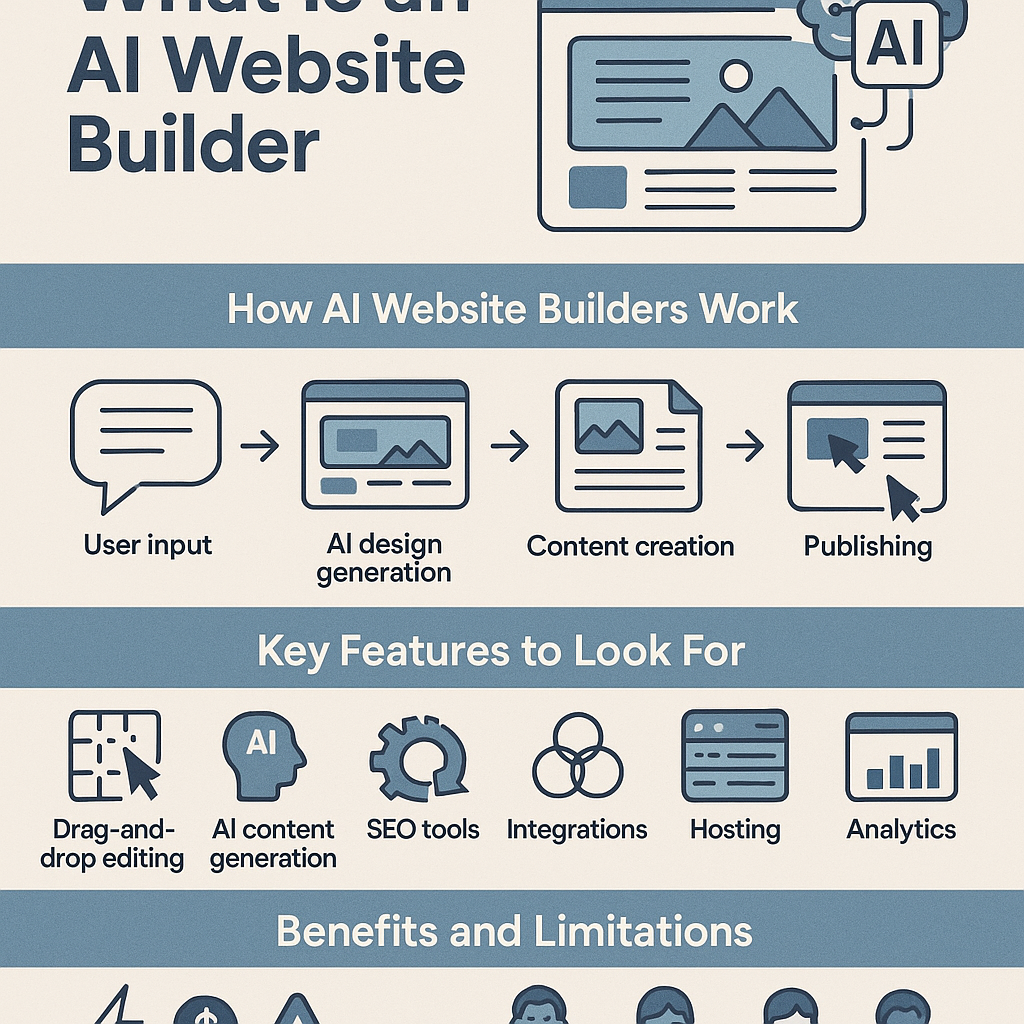
How AI Website Builders Work
The operation of an AI website builder typically unfolds through several distinct steps, each leveraging AI to varying degrees:
User Input
The process begins with the user providing essential information, often via a guided questionnaire or simple prompts. This input may include business type, target audience, preferred styles, key services or products, and content goals.
AI Design Generation
Based on the collected data, the AI engine generates a unique website design. This includes layout arrangements, color palettes, font choices, and image suggestions. The AI uses pattern recognition and design principles to create an appealing visual structure suited to the user’s needs.
Content Creation
Some AI builders go further by producing textual content automatically. Using natural language processing (NLP), the AI drafts copy that aligns with the website’s purpose, such as About pages, service descriptions, or blog ideas. This content can often be edited by the user afterward.
Customization
After the initial AI-generated draft, users can personalize the website further. Customization options typically include editing text, replacing images, adjusting layouts, and modifying colors. This step ensures that the final product reflects the user’s unique voice and branding.
Publishing
Once satisfied, the user can publish the website directly through the platform. Many AI website builders offer integrated hosting and domain management, simplifying the launch process.
Key Features to Look For
Drag-and-Drop Editing
While AI generates the initial design, intuitive drag-and-drop editors enable users to tweak the website easily without coding. This feature ensures flexibility and control over the final appearance.
AI Content Generation
The ability to produce relevant text automatically saves time and supports users who may struggle with writing. Look for builders that offer content suggestions or auto-generated copy tailored to your industry.
SEO Tools
Effective AI builders include SEO assistance such as keyword recommendations, meta tag creation, and site structure optimization. These tools help improve your website’s discoverability on search engines.
Integrations
Integration capabilities with third-party services—like email marketing platforms, social media, payment gateways, and analytics—expand the website’s functionality and support business growth.
Hosting
Many AI website builders provide all-in-one solutions that include reliable hosting, domain registration, and SSL certificates. This reduces the need for multiple providers and technical setup.
Analytics
Built-in analytics dashboards allow users to monitor traffic, visitor behavior, and conversion metrics, enabling informed decisions to optimize website performance.
Benefits and Limitations
Benefits:
- Speed: AI automates many time-consuming tasks, enabling website creation in hours instead of days or weeks.
- Cost Savings: Reduces the need for hiring web designers, developers, or content writers, making it budget-friendly for small businesses.
- Ease of Use: Designed for non-technical users, enabling entrepreneurs and creators to build professional websites without coding knowledge.
Limitations:
- Customization Constraints: While AI generates a solid baseline, extensive personalization might be limited compared to traditional custom development.
- Dependence on AI Structure: The website’s look and functionality may feel templated or generic if the AI-generated framework is not sufficiently adaptable.
- Content Quality: Automatically generated text may require careful editing to ensure accuracy, relevance, and brand voice alignment.
Who Should Use an AI Website Builder?
AI website builders are particularly well-suited for:
- Entrepreneurs and Startups: Those needing a quick, cost-effective online presence without technical overhead.
- Small Business Owners: Businesses with limited budgets and no in-house web teams can benefit from streamlined website creation.
- Bloggers and Creators: Individuals looking to establish personal brands or portfolios with minimal fuss.
- Non-technical Users: Anyone who lacks coding skills but wants control over their website’s look and content.
Checklist for Evaluating AI Website Builders
- Does it provide intuitive user input options to capture your website goals and preferences?
- How robust and customizable is the AI-generated design and layout?
- Is AI-powered content generation relevant, accurate, and editable?
- Are SEO tools comprehensive and easy to use?
- Does it support necessary third-party integrations important to your business?
- Is hosting included, and what are the reliability and speed benchmarks?
- Are analytics and visitor tracking features available?
- How flexible is the drag-and-drop editor for post-generation customization?
- What pricing plans exist, and do they fit your budget and expected growth?
- Are customer support and tutorials accessible to assist you?
Choosing an AI website builder involves balancing automation convenience with the need for creative control and functionality. By understanding how these tools work and what features matter most, you can make an informed decision that aligns with your website goals and resources.
![Understanding AI Website Builders: How They Work and Who Should Use Them [2026-05-29 11:58:17 1bv161]](https://getwpai.com/wp-content/uploads/2026/05/getwpai-20260529-115817.png)
![Mastering AI-Powered Content Automation in WordPress: A Strategic Guide for Scalable Growth [2026-05-25 11:43:01 rdw72k]](https://getwpai.com/wp-content/uploads/2026/05/getwpai-20260525-114301.png)