Introduction
Scaling blog traffic on WordPress demands more than generic advice — it requires tactical, measurable strategies grounded in data and automation. Whether you’re an affiliate marketer, SaaS founder, or agency managing multiple sites, implementing precise workflows can transform your organic reach. This guide dives deep into actionable methods to grow your blog traffic using WordPress, focusing on keyword research, content structure, internal linking, content velocity, programmatic SEO, and automation tools.
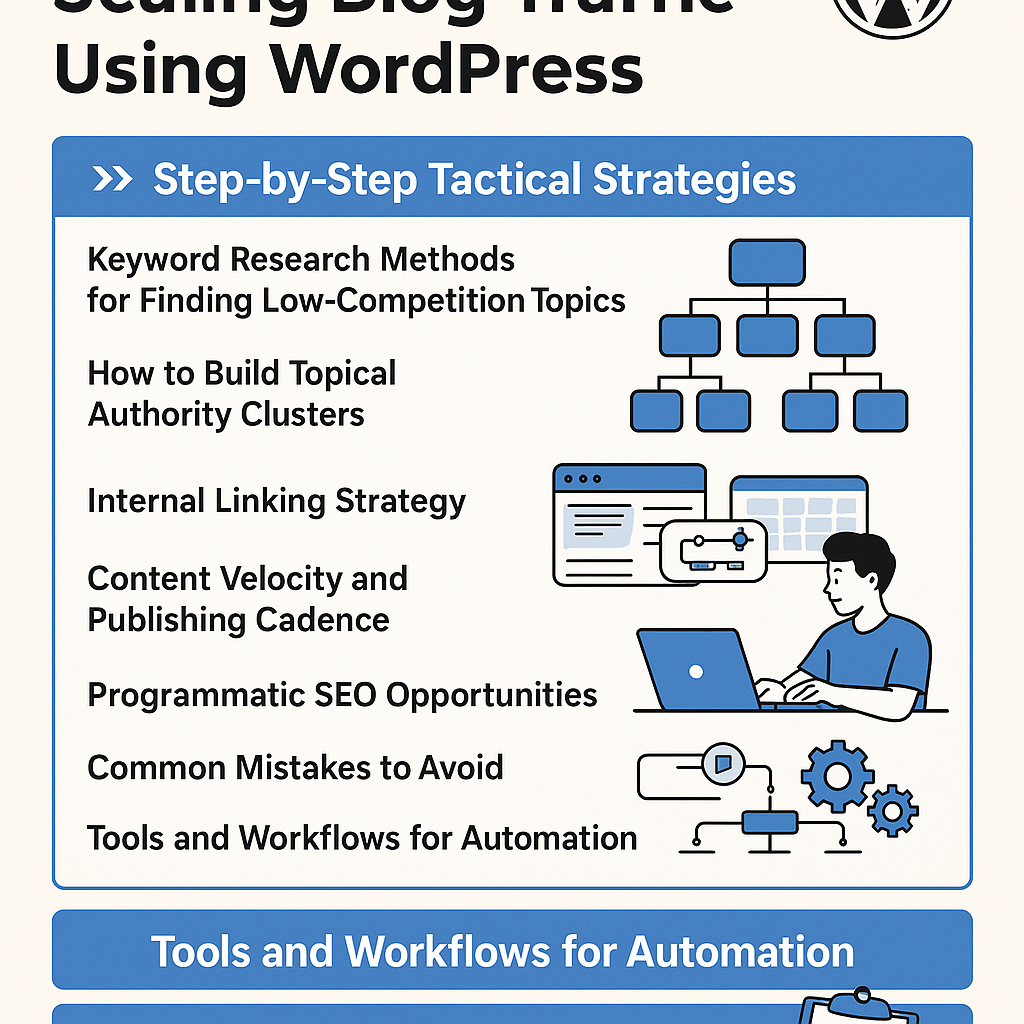
Step 1: Target Low-Competition Keywords with Precision
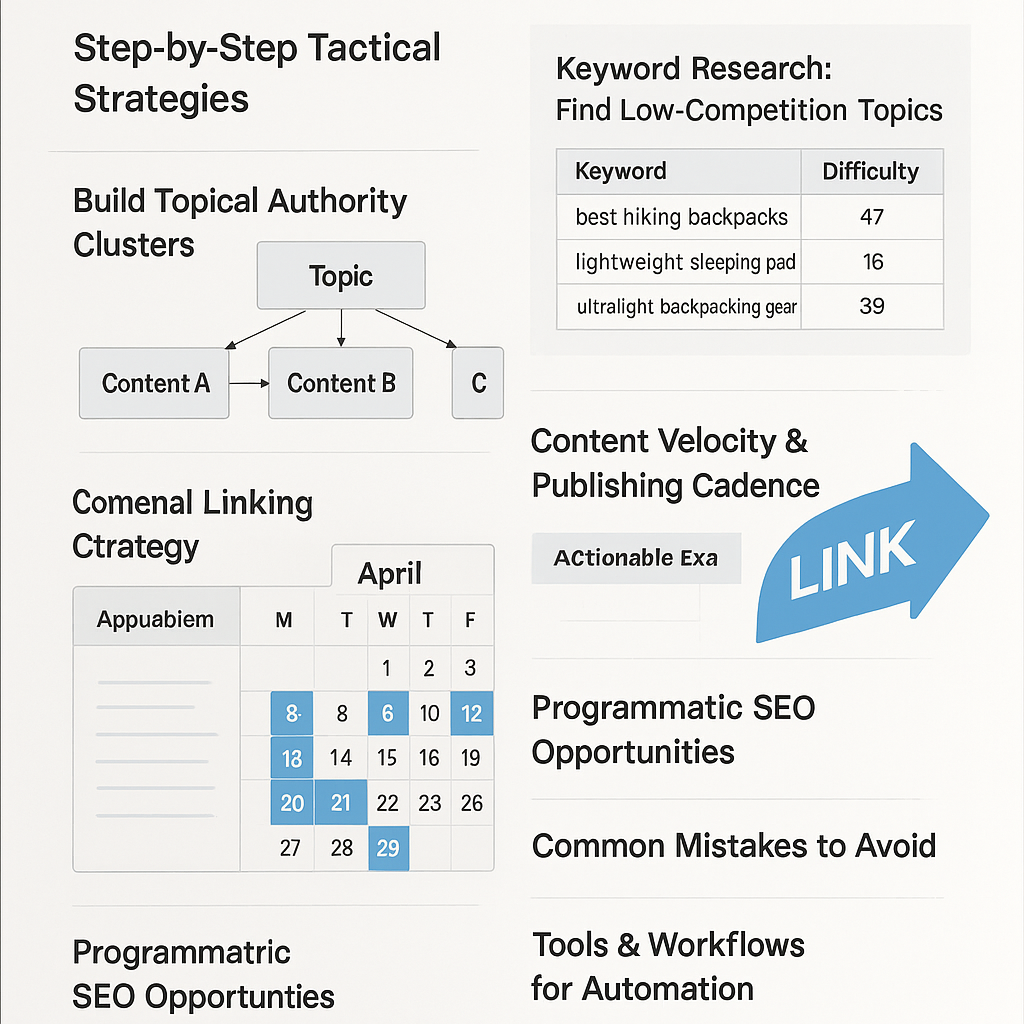
Advanced Keyword Research Methods
Begin by mining keywords that provide high ROI but face minimal competition. Use tools like Ahrefs, SEMrush, or the free Google Keyword Planner combined with Google Search Console data to identify:
- Long-tail keywords with keyword difficulty (KD) below 20.
- Questions and prepositions featured in People Also Ask boxes.
- Low-competition niches revealed via Google Trends regional spikes or seasonal data.
Example: Instead of targeting “email marketing,” find subtopics like “email marketing automation tools for SaaS startups” with a manageable search volume but low competition.
Tools and Workflow
- Export keyword lists from Ahrefs with filters for KD <20 and volume >100.
- Cross-reference with Google Search Console to identify existing low-performing pages you can optimize.
- Use Surfer SEO’s content editor to analyze competitor content on selected keywords.
Step 2: Build Topical Authority Clusters
Structuring Your Content for Authority
Topical clusters are groups of interlinked pages centered on a broad pillar topic with detailed cluster content supporting it. This approach consolidates your site’s relevance in Google’s eyes.
How to implement:
- Create a pillar page: A comprehensive, authoritative guide on a broad subject (e.g., “Complete Guide to SaaS Growth Marketing”).
- Develop cluster posts: Target related long-tail keywords (e.g., “SaaS onboarding email templates,” “SaaS customer success KPIs”) that link back to the pillar.
- Interlink strategically: Each cluster post links to the pillar and other cluster posts, distributing link equity.
Example Internal Linking HTML Snippet
<p>For a deeper understanding, check our <a href="/saas-growth-marketing-guide">Complete Guide to SaaS Growth Marketing</a>.</p>Step 3: Optimize Internal Linking to Amplify Page Authority
Internal Linking Strategy
Internal links pass PageRank and help Google discover and rank pages more effectively. A data-driven approach involves:
- Using anchor text variations focused on target keywords.
- Ensuring every cluster post links back to the pillar page.
- Leveraging WordPress plugins like Link Whisper to automate and suggest contextual internal links.
- Regular audits to fix broken links and remove orphan pages.
Actionable Example
After publishing a cluster post on “SaaS onboarding email templates,” immediately add internal links to the pillar page and to older cluster posts like “SaaS customer success KPIs,” using anchor texts such as:
- “SaaS onboarding best practices”
- “Customer success metrics for SaaS”
Step 4: Maintain Content Velocity with a Data-Driven Publishing Cadence
Balancing Quantity and Quality
Consistent content output signals to search engines that your site is active and authoritative. However, volume without quality can backfire. The goal is to publish high-quality cluster posts regularly, then update pillar pages quarterly.
Recommended cadence:
- 2-3 cluster posts per week focused on low-competition keywords.
- 1 pillar page update every 3 months with fresh data and additional content.
Measurement: Track organic traffic growth, keyword rankings, and crawl frequency via Google Search Console.
Step 5: Leverage Programmatic SEO Opportunities
Scaling with Dynamic, Template-Based Content
Programmatic SEO involves creating hundreds or thousands of pages using data-driven templates to capture long-tail search queries.
Use cases: Product comparison pages, location-specific landing pages, or software feature pages.
Implementation on WordPress:
- Use custom post types and Advanced Custom Fields (ACF) to create structured templates.
- Import datasets via CSV or API to auto-generate pages with unique metadata and content blocks.
- Ensure canonical tags and noindex tags prevent duplicate content issues.
Example:
For an affiliate blog reviewing SaaS tools, auto-generate pages for each software feature combined with user reviews and pricing data, targeting queries like “best SaaS CRM with automation in 2026.”
Step 6: Avoid Common Pitfalls
- Neglecting Internal Linking: Missing links between cluster content and pillar pages dilute topical authority.
- Overloading Programmatic Pages: Thin or duplicated content harms SEO.
- Ignoring Content Refresh: Outdated pillar pages lose rankings over time.
- Publishing Without SEO Analysis: Random content without keyword intent wastes resources.
- Lack of Automation: Manual processes limit scalable growth.
Step 7: Automate with Tools and Optimized Workflows
Recommended Tools
- Keyword Research: Ahrefs, SEMrush, Google Search Console.
- Content Optimization: Surfer SEO, Clearscope.
- Internal Linking Automation: Link Whisper plugin.
- Programmatic SEO: Custom scripts, WP All Import, ACF.
- Publishing & Workflow Automation: WordPress editorial calendar plugins, Zapier for task automation.
Workflow Example
- Identify keyword clusters monthly via Ahrefs + Search Console.
- Use Surfer SEO to draft content outlines automatically.
- Publish cluster posts via WordPress editorial calendar.
- Automate internal linking recommendations with Link Whisper.
- Update pillar pages quarterly based on content gaps.
Practical Implementation Checklist
- Conduct low-competition keyword research targeting KD <20.
- Create and map pillar pages with supporting cluster posts.
- Implement a rigorous internal linking structure using anchor text variations.
- Set a publishing cadence: 2-3 cluster posts weekly; pillar page updates quarterly.
- Deploy programmatic SEO for scalable, data-driven page creation.
- Audit your site monthly for broken links and orphan pages.
- Use Link Whisper or similar tools to automate internal linking suggestions.
- Leverage Surfer SEO or Clearscope for content quality benchmarks.
- Automate repetitive tasks with Zapier and WP All Import.
- Monitor performance consistently with Google Analytics and Search Console.
By integrating these precise, tactical strategies into your WordPress blog management, you can scale organic traffic methodically and sustainably. The combination of targeted keyword research, authoritative content clusters, smart internal linking, and automation workflows is your blueprint for measurable growth without unnecessary guesswork.
![Understanding AI Website Builders: How They Work and Who Should Use Them [2026-05-29 11:58:17 1bv161]](https://getwpai.com/wp-content/uploads/2026/05/getwpai-20260529-115817.png)
![Mastering AI-Powered Content Automation in WordPress: A Strategic Guide for Scalable Growth [2026-05-25 11:43:01 rdw72k]](https://getwpai.com/wp-content/uploads/2026/05/getwpai-20260525-114301.png)