Introduction
Growing blog traffic beyond initial traction requires more than generic SEO tips. Serious WordPress site owners, affiliate marketers, SaaS founders, and agencies must adopt precise, tactical approaches that maximize organic reach while conserving resources. This guide dives deep into advanced strategies—step-by-step—for scaling WordPress blog traffic, with a strong emphasis on automation and programmatic SEO without the usual fluff.
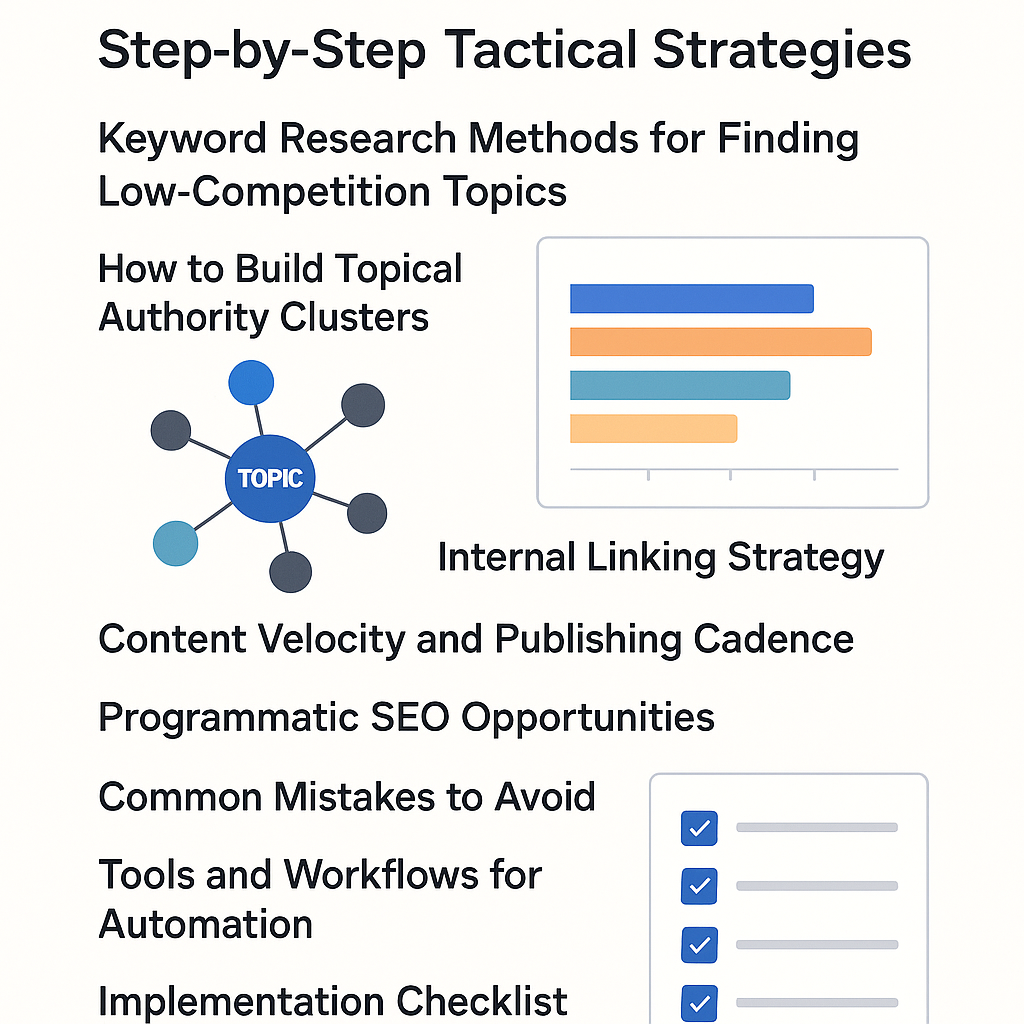
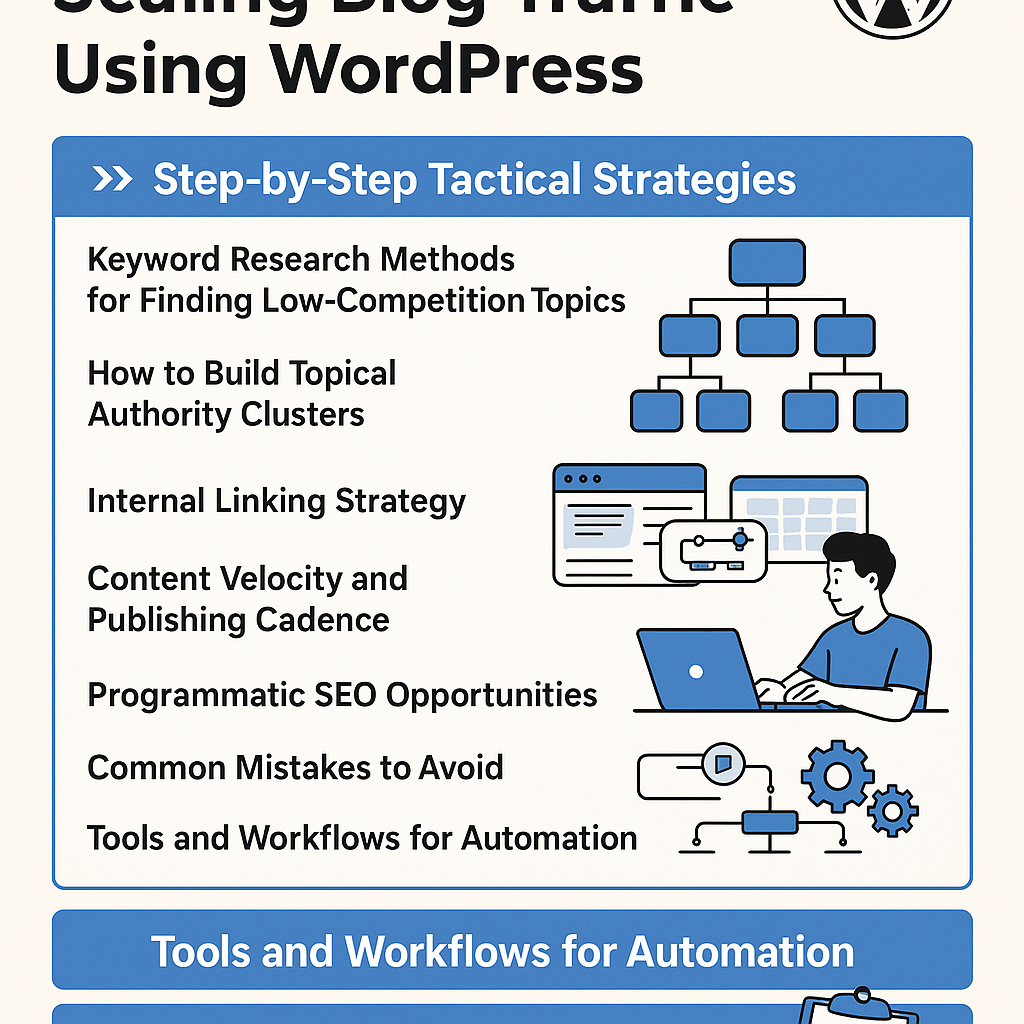
Step 1: Precision Keyword Research for Low-Competition Topics
Effective scaling begins with identifying untapped keyword opportunities that have meaningful search volume but low competition. Here’s how to do it:
Tools & Methodology
- Use Keyword Explorer Tools: Tools like Ahrefs, SEMrush, and Moz provide detailed keyword difficulty scores and SERP analysis.
- Filter by Keyword Difficulty: Set a threshold (e.g., KD < 20) to find easier-to-rank-for topics.
- Leverage Google’s “People Also Ask” and Related Searches: These sections reveal user intent clusters around your niche.
- Search Intent Validation: Confirm that the top-ranking pages align with your content goals (informational, transactional, etc.).
Example
If you run a SaaS blog about project management, look beyond generic terms like “project management software” and instead target “best project scheduling techniques for remote teams” — a phrase with moderate volume and lower competition.
Step 2: Building Topical Authority Clusters
Topical clusters improve site relevance and boost rankings by organizing content into interlinked hubs and subtopics.
How to Structure Clusters
- Pillar Page: Create a comprehensive guide covering a broad topic.
- Cluster Content: Develop supporting articles diving into subtopics, each linking back to the pillar.
- Consistent Keyword Themes: Use semantic variations and latent semantic indexing (LSI) keywords to reinforce the topic.
Example
For a WordPress SEO blog, your pillar could be “Complete Guide to WordPress SEO” with clusters like “How to Optimize WordPress Speed,” “Best SEO Plugins for WordPress,” and “WordPress Schema Markup Tutorial.” Each cluster page internally links to the pillar and other related cluster pages.
Step 3: Implementing a Strategic Internal Linking Framework
Internal linking distributes link equity, improves crawlability, and enhances user navigation—critical for scaling traffic.
Tactical Internal Linking Tips
- Use Descriptive Anchor Text: Avoid generic phrases; use keywords relevant to the linked page.
- Link Deeper Pages to Pillars: Ensure cluster pages link back to the pillar and vice versa.
- Limit Links Per Page: Keep internal links to a reasonable number (20-30) to avoid dilution.
- Automate Suggestions: Use plugins like Link Whisper or custom scripts to surface internal linking opportunities as you publish.
Example
While publishing a post on “WordPress Speed Optimization,” automatically suggest links to the “Complete Guide to WordPress SEO” pillar and other relevant cluster posts.
Step 4: Optimizing Content Velocity and Publishing Cadence
Consistent publishing with a data-driven cadence signals relevance to search engines and builds topical depth.
Recommended Approach
- Initial Ramp-Up: Publish 3-5 posts per week for 4-6 weeks to build momentum.
- Steady-State Publishing: Maintain 1-2 quality posts weekly to sustain growth.
- Monitor Performance: Use Google Analytics and Search Console to identify content gaps and optimize cadence.
Automation Tip
Plan editorial calendars using tools like Trello or Airtable integrated with WordPress via Zapier to streamline publishing workflows.
Step 5: Harnessing Programmatic SEO Opportunities
Programmatic SEO automates the creation of large volumes of hyper-targeted pages, ideal for niches with structured data.
Applying Programmatic SEO on WordPress
- Identify Scalable Data Sets: Examples include product specs, locations, or service variations.
- Use Custom Post Types and Taxonomies: Organize content systematically.
- Automate Page Generation: Use plugins or custom scripts to generate content templates populated dynamically from your data.
- Optimize Metadata at Scale: Use templates for titles, descriptions, and schema markup.
Example
A SaaS company could generate landing pages for every industry and use case combination they serve, programmatically populating each page with tailored content, testimonials, and CTAs.
Step 6: Common Pitfalls to Avoid
- Overstuffing Keywords: Leads to penalization and poor UX.
- Neglecting Internal Linking: Missed opportunity for SEO and engagement.
- Publishing Low-Quality Content Quickly: Damages authority and user trust.
- Ignoring Analytics: Failing to analyze and adjust strategy based on data.
Step 7: Tools and Workflows for Automation
Automation reduces manual workload and supports scaling.
Recommended Tools
- Keyword Research: Ahrefs API, SEMrush API for bulk data extraction.
- Content Planning: Airtable + Zapier for editorial calendar automation.
- Internal Linking: Link Whisper plugin for automatic suggestions and link management.
- Programmatic Content: Custom WordPress plugins or third-party tools like RankMath’s Schema Generator.
- Publishing Automation: Use WordPress REST API to automate post creation and scheduling.
Workflow Example
Collect keyword data via API → filter low-competition targets → add to Airtable editorial calendar → auto-create WordPress drafts via Zapier → suggest internal links with Link Whisper → schedule posts for publishing → monitor performance in Google Analytics.
Practical Implementation Checklist
- Conduct keyword research focusing on KD < 20 and validate search intent.
- Create pillar content and 5-10 cluster articles forming a topical authority hub.
- Implement descriptive, strategic internal linking between clusters and pillar pages.
- Establish a publishing cadence: ramp up to 3-5 posts/week, then settle to 1-2 quality posts/week.
- Explore programmatic SEO by identifying scalable data sets and automating page creation.
- Avoid keyword stuffing, low-quality posts, and neglecting internal links.
- Set up automation tools: integrate keyword APIs, editorial calendar workflows, internal linking plugins, and publishing automation.
- Regularly review Google Analytics and Search Console data to iterate and refine your strategy.
Scaling blog traffic using WordPress requires a blend of precise keyword targeting, structured content organization, and smart automation. By following these tactical steps, serious site owners can build authoritative, efficient, and scalable blogs that drive sustainable organic growth.
![Understanding AI Website Builders: How They Work and Who Should Use Them [2026-05-29 11:58:17 1bv161]](https://getwpai.com/wp-content/uploads/2026/05/getwpai-20260529-115817.png)
![Mastering AI-Powered Content Automation in WordPress: A Strategic Guide for Scalable Growth [2026-05-25 11:43:01 rdw72k]](https://getwpai.com/wp-content/uploads/2026/05/getwpai-20260525-114301.png)