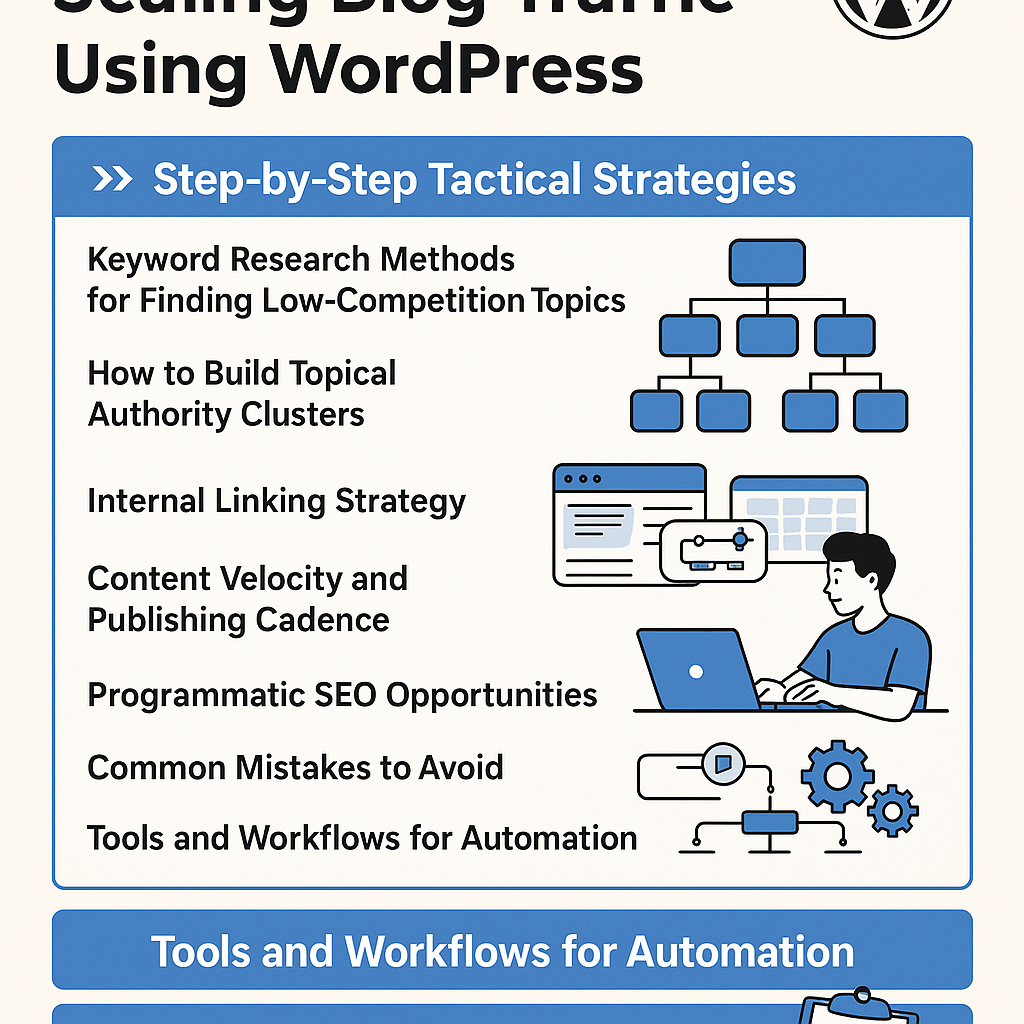
Introduction
Growing blog traffic on WordPress requires more than generic tips—it demands deliberate, tactical strategies that scale efficiently. Whether you’re a SaaS founder, affiliate marketer, or agency managing multiple sites, mastering advanced SEO and content workflows can exponentially increase organic reach. This guide dives deep into actionable methods, from low-competition keyword research to scalable automation, ensuring your efforts translate into measurable growth.
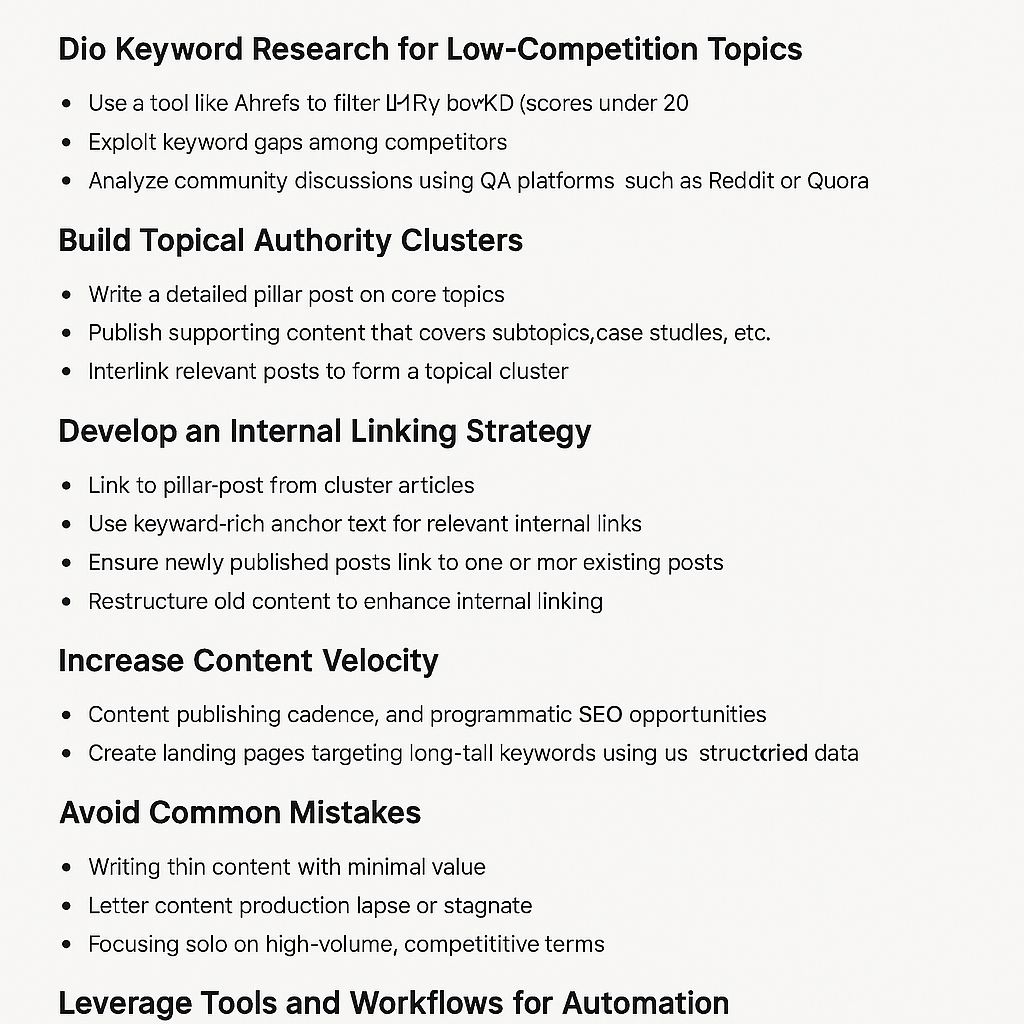
Step-by-Step Keyword Research for Low-Competition Topics
Effective keyword research lays the foundation for scalable traffic. Focus on uncovering low-competition keywords with meaningful search volume to build momentum.
1. Use Niche-Specific Seed Keywords
Start with highly relevant seed keywords reflecting your niche’s core themes. For example, a SaaS blog might begin with “email automation tools” or “CRM integrations.”
2. Leverage Advanced Keyword Tools
- Keywords Everywhere: Quickly scan search volume and CPC data.
- Ahrefs Keyword Explorer: Use the “Keyword Difficulty” filter to isolate keywords with low competition scores (below 20).
- Google Search Console (GSC): Identify long-tail queries already driving impressions but low clicks.
3. Analyze Competitor Gaps
Use tools like Ahrefs Content Gap or SEMrush Keyword Gap to spot keywords your competitors rank for but you don’t. Prioritize those with moderate volume and low difficulty.
4. Validate with SERP Analysis
Manually review the top 10 results for your target keywords. Avoid highly authoritative sites dominating the space, aiming instead for topics with informational intent and fragmented competition.
Building Topical Authority Clusters
Topical clusters help establish your site as an authoritative resource, improving rankings across related queries.
1. Identify Pillar Topics
Select broad, high-level subjects central to your niche. For example, “WordPress SEO strategies” or “affiliate marketing tools.”
2. Create Supporting Cluster Content
Develop multiple in-depth posts targeting long-tail variations and subtopics, such as “optimizing internal links in WordPress” or “best affiliate plugins for WordPress.”
3. Interlink Strategically Between Pillars and Clusters
Link cluster articles back to the pillar and vice versa, signaling semantic relevance to search engines.
Internal Linking Strategy for Scalability
Internal linking distributes page authority and improves crawlability, essential for scaling organic traffic.
1. Map Your Content Structure
Create a content spreadsheet categorizing posts by topic clusters. This visual map guides logical linking paths.
2. Use Anchor Text Variation
Incorporate natural, descriptive anchor texts that include target keywords without over-optimization.
3. Automate with Plugins
Plugins like Link Whisper can suggest internal links during post creation, accelerating workflow without sacrificing quality.
Optimizing Content Velocity and Publishing Cadence
Consistent publishing accelerates indexation and signals freshness to search engines.
1. Define a Realistic Cadence
Start with 2-3 posts per week focusing on quality and topical relevance. Scale up as workflows and resources improve.
2. Batch Content Production
Use editorial calendars and batch writing sessions to maintain steady output without burnout.
3. Monitor Performance and Adjust
Track content KPIs (traffic, engagement) and pivot topics or cadence based on what drives growth.
Harnessing Programmatic SEO Opportunities
Programmatic SEO allows automated creation of large-scale, data-driven pages targeting numerous keyword permutations.
1. Identify Scalable Content Models
Examples include:
- Location-based service pages
- Product or feature comparison tables
- FAQ pages generated from structured data
2. Use WordPress Custom Post Types and Taxonomies
Structure programmatic pages efficiently to maintain site organization and avoid duplication.
3. Automate Content Generation
Integrate APIs or CSV imports to populate templates dynamically. For instance, a SaaS blog might generate comparison pages for 100+ software categories.
Common Mistakes to Avoid
- Ignoring Search Intent: Targeting keywords without matching user intent leads to high bounce rates.
- Weak Internal Linking: Overlooking internal links wastes SEO potential.
- Content Cannibalization: Publishing multiple posts on very similar keywords dilutes authority.
- Inconsistent Publishing: Irregular content disrupts crawl frequency and audience engagement.
- Over-Reliance on Automation Without QA: Automated content or links must be vetted to maintain quality.
Tools and Workflows for Automation
1. Keyword Research and Topic Discovery
- Ahrefs API for bulk keyword data extraction.
- Google Search Console API for performance insights.
2. Content Creation and Scheduling
- WordPress Editorial Calendar plugin for planning.
- AI-assisted drafting tools integrated via API for rapid initial drafts.
3. Internal Linking Automation
- Link Whisper plugin to automate internal link suggestions and reporting.
4. Programmatic Page Generation
- Custom scripts or plugins to pull from structured data to create templated pages.
Practical Implementation Checklist
- Conduct low-competition keyword research using Ahrefs and GSC focusing on intent alignment.
- Map out at least 3 pillar topics and create 5-7 cluster posts per pillar.
- Implement internal linking strategy using Link Whisper to connect pillar and cluster content.
- Set publishing cadence to 2-3 posts per week; batch content production to maintain consistency.
- Identify at least one programmatic SEO opportunity and develop templated page structure.
- Automate keyword tracking and internal linking suggestions with APIs and plugins.
- Regularly audit for content cannibalization and adjust overlapping posts.
- Set up QA processes for all automated content or link generation to ensure quality.
By applying these advanced tactics with precision and discipline, you can systematically scale your WordPress blog traffic while building durable topical authority and operational efficiency.
![Understanding AI Website Builders: How They Work and Who Should Use Them [2026-05-29 11:58:17 1bv161]](https://getwpai.com/wp-content/uploads/2026/05/getwpai-20260529-115817.png)
![Mastering AI-Powered Content Automation in WordPress: A Strategic Guide for Scalable Growth [2026-05-25 11:43:01 rdw72k]](https://getwpai.com/wp-content/uploads/2026/05/getwpai-20260525-114301.png)