Introduction
Growing organic traffic on WordPress requires more than publishing content regularly. It demands a strategic, methodical approach centered on data, automation, and precision. This guide covers advanced tactics tailored for WordPress site owners, affiliate marketers, SaaS founders, and agencies aiming to scale traffic efficiently and sustainably.
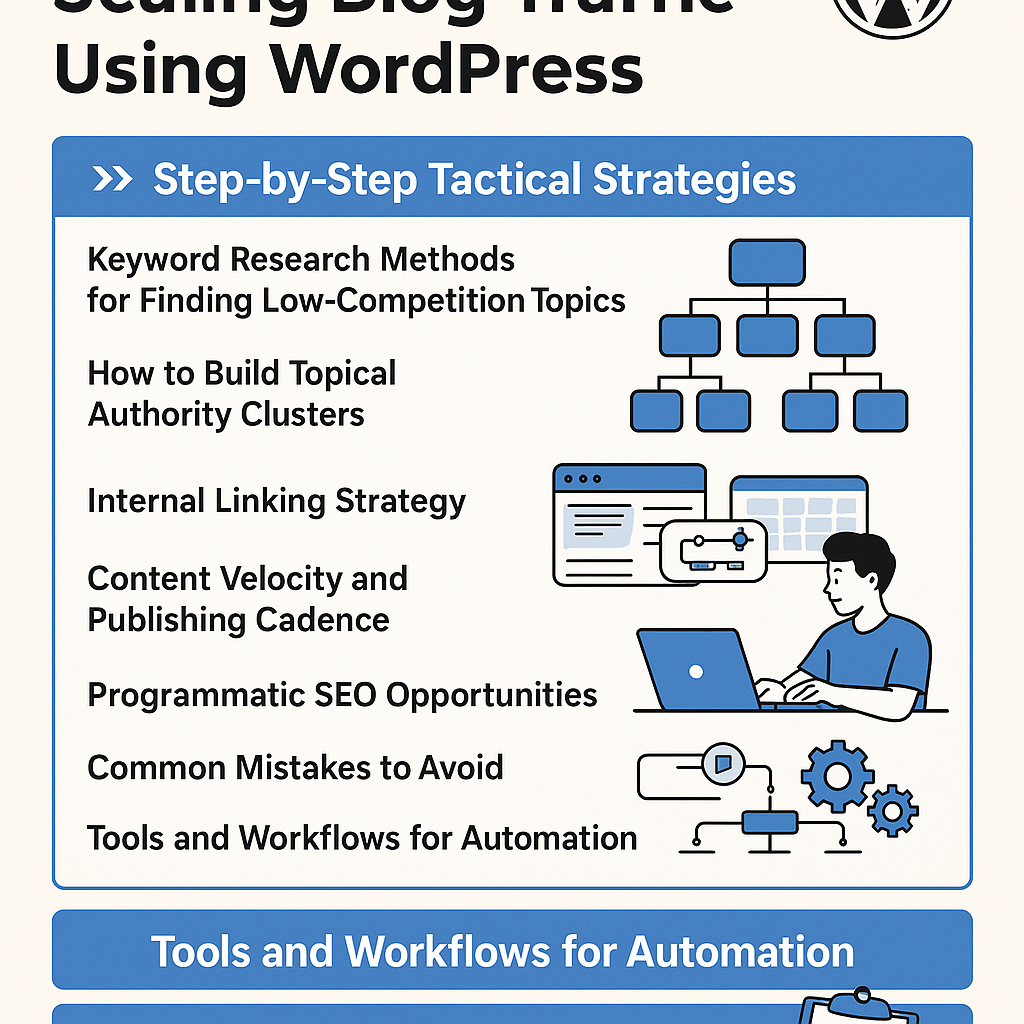
Step 1: Tactical Keyword Research for Low-Competition Opportunities
Start by uncovering keywords that balance search volume with low competition. Avoid broad, hyper-competitive terms and instead focus on niche-specific long-tail keywords that your competitors overlook.
Actionable Methods:
- Use Keyword Gap Analysis: Compare your site’s keyword profile against top competitors using tools like Ahrefs or SEMrush to find keywords they rank for, but you don’t.
- Leverage Google’s “People Also Ask” and Related Searches: These sections reveal user intent variations you can target with dedicated posts.
- Filter by Keyword Difficulty: Set a threshold (e.g., below 30 KD in Ahrefs) to prioritize low-competition keywords.
- Validate with Search Console Data: Identify queries your site already ranks for on page 2 or 3 and optimize these posts to move them up.
Step 2: Building Topical Authority Clusters
Topical authority clusters organize content around a central pillar page, supported by multiple interlinked subtopics. This structure signals relevance to search engines and improves rank potential.
Implementation:
- Create a Pillar Page: Develop a comprehensive guide that broadly covers a high-level topic relevant to your niche.
- Develop Cluster Content: Write detailed posts addressing narrower subtopics linked from the pillar page.
- Cross-Link Wisely: Ensure clusters link back to the pillar page and interlink with each other to distribute link equity.
- Example: For a SaaS blog focusing on “Customer Retention,” the pillar page covers broad strategies, while cluster posts dive into churn analysis, engagement tactics, and loyalty programs.
Step 3: Optimizing Internal Linking for SEO and UX
Internal links help search engines discover content and distribute ranking power. A strategic internal linking framework improves crawl efficiency and user navigation.
Best Practices:
- Use Descriptive Anchor Text: Avoid generic anchors like “click here”; instead, use keyword-rich phrases that describe the linked page.
- Prioritize Deep Linking: Link to posts beyond the homepage and main category pages to boost less visible content.
- Maintain a Logical Hierarchy: Link cluster pages to their pillar and vice versa, reinforcing topical relevance.
- Automated Suggestions: Employ WordPress plugins like Yoast Internal Linking or Link Whisper to identify optimal link opportunities.
Step 4: Content Velocity and Publishing Cadence
Consistent publishing helps maintain momentum with search engines. However, quantity should never compromise quality.
Strategic Approach:
- Set Realistic Cadence: For most serious blogs, 1–3 high-quality posts per week work best to sustain growth without burnout.
- Batch Content Production: Use editorial calendars and batch writing sessions to streamline publishing.
- Repurpose and Update: Refresh existing content regularly to maintain relevance and keyword rankings.
Step 5: Exploring Programmatic SEO Opportunities
Programmatic SEO automates the creation of large-scale, template-driven pages targeting specific keyword variations, locations, or product attributes.
How to Apply on WordPress:
- Identify Scalable Content Themes: Examples include local business directories, product review pages, or event listings.
- Use Custom Post Types (CPTs) and Taxonomies: Structure data with WordPress CPTs to automate page generation.
- Leverage Plugins and APIs: Tools like Toolset or Advanced Custom Fields (ACF) combined with templating can generate hundreds of unique pages.
- Example: An affiliate marketer could programmatically generate product comparison pages based on brand, price, and features.
Step 6: Common Pitfalls to Avoid
- Overloading with Keywords: Keyword stuffing harms readability and rankings.
- Neglecting User Experience: Poor navigation or slow site speed deters visitors.
- Ignoring Link Quality: Avoid excessive linking to low-value pages; focus on relevance.
- Inconsistent Publishing: Large gaps between posts reduce crawl frequency.
- Over-automation Without Oversight: Automated content or links require manual review to ensure quality.
Step 7: Tools and Workflows for Automation
Automation can reduce manual effort and increase scale but requires disciplined workflows.
Recommended Tools:
- Keyword Research: Ahrefs, SEMrush, Google Search Console API for continuous monitoring.
- Content Planning: Airtable or Trello integrated with editorial calendars.
- Internal Linking Automation: Link Whisper plugin for WordPress.
- Programmatic SEO: Toolset, ACF, WP All Import for bulk content management.
- Publishing Automation: WordPress REST API combined with custom scripts for scheduled bulk publishing.
Workflow Example:
- Run weekly keyword gap reports automatically via API.
- Feed target keywords into Airtable for content assignments.
- Batch write and schedule posts via WordPress editor or API.
- Use Link Whisper to update internal links immediately after publishing.
- Monitor performance with Search Console and adjust strategy monthly.
Conclusion: Practical Implementation Checklist
- Conduct keyword gap analysis focusing on low-competition, long-tail terms.
- Design a pillar page and build at least 3 cluster posts around it.
- Implement internal linking with descriptive anchor texts using automated suggestions.
- Establish a consistent publishing schedule targeting 1–3 quality posts weekly.
- Identify at least one programmatic SEO opportunity and set up CPTs with templating.
- Audit your site for keyword stuffing, UX issues, and link quality.
- Set up automated workflows with keyword research, content planning, publishing, and internal linking tools.
- Review performance monthly and refine based on data insights.
By applying these advanced, tactical strategies within WordPress, you position your blog for scalable, sustainable organic traffic growth driven by data and automation rather than guesswork.
![Understanding AI Website Builders: How They Work and Who Should Use Them [2026-05-29 11:58:17 1bv161]](https://getwpai.com/wp-content/uploads/2026/05/getwpai-20260529-115817.png)
![Mastering AI-Powered Content Automation in WordPress: A Strategic Guide for Scalable Growth [2026-05-25 11:43:01 rdw72k]](https://getwpai.com/wp-content/uploads/2026/05/getwpai-20260525-114301.png)