Introduction
For WordPress site owners, affiliate marketers, SaaS founders, and agencies, scaling blog traffic requires more than just publishing posts. It demands a strategic, data-driven approach that leverages advanced SEO tactics tailored to WordPress’s ecosystem. This article delves into step-by-step strategies to boost your organic traffic efficiently, focusing on keyword research, topical authority, internal linking, content velocity, programmatic SEO, and automation workflows.
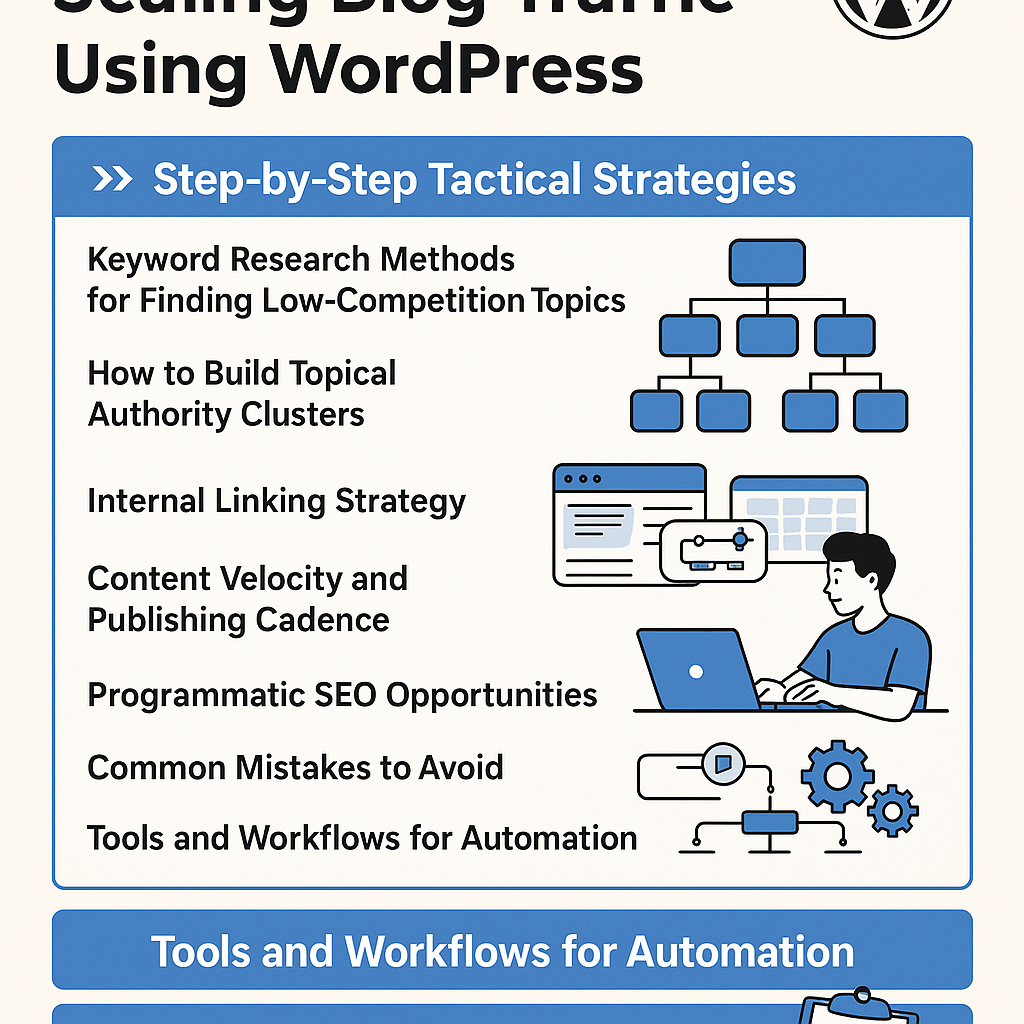
Step-by-Step Tactical Strategies to Scale Traffic
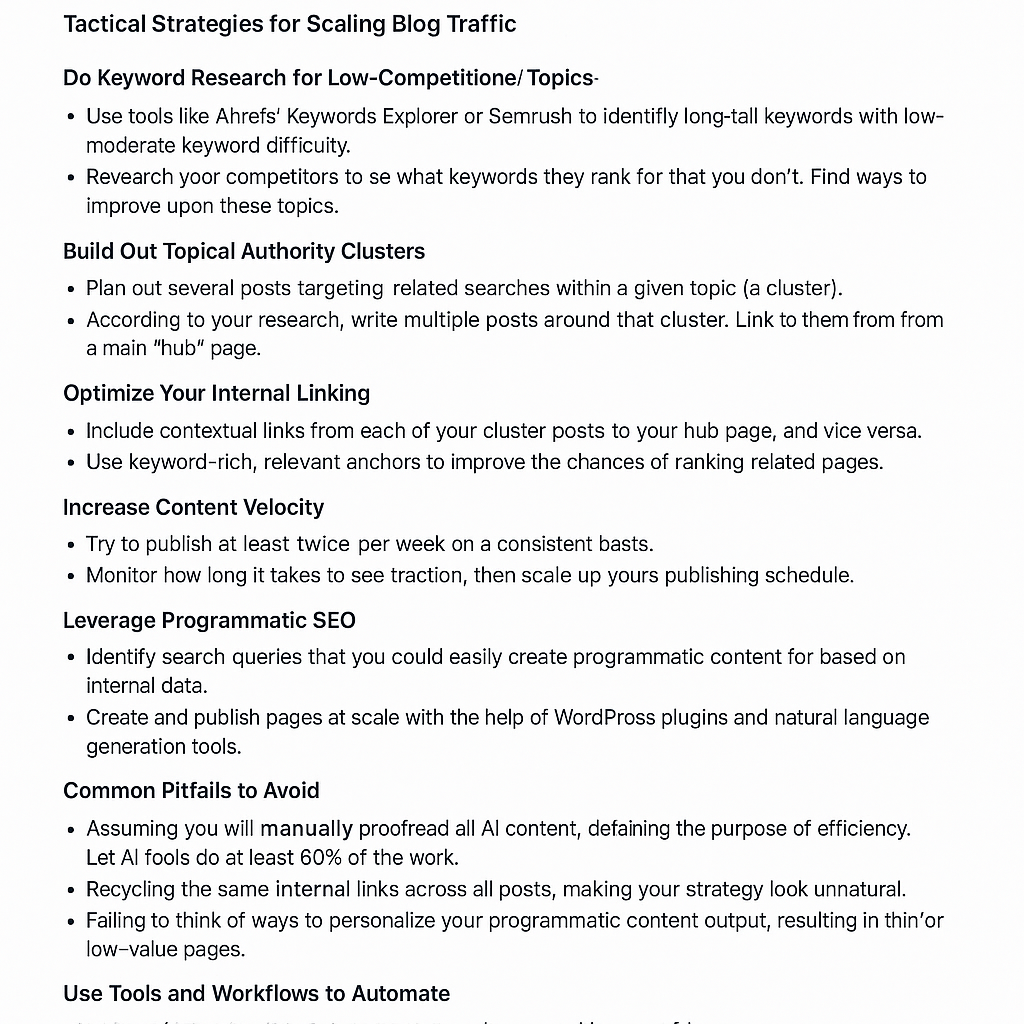
1. Conduct Laser-Focused Keyword Research for Low-Competition Niches
Generic keyword research tools can overwhelm with volume but lack precision for low-competition opportunities. Use a combination of the following methods:
- Seed Keywords + Google’s “People Also Ask” & Related Searches: Extract long-tail variations with lower difficulty by examining these Google SERP features.
- Use Advanced Filters in Tools like Ahrefs or SEMrush: Filter keywords by KD (Keyword Difficulty) below 15 and search volume above 100 monthly searches to find hidden gems.
- Leverage Google Search Console (GSC) Data: Identify queries your site already ranks for on page 2 or 3; these are prime targets for content expansion or optimization.
Example: If your WordPress blog is about SaaS productivity tools, target a keyword like “best time tracking apps for remote teams” instead of the highly competitive “time tracking apps.”
2. Build Topical Authority Clusters
Topical clusters group related content around a central pillar page to signal expertise to search engines.
- Create a Pillar Page: Develop a comprehensive guide on a broad topic.
- Write Cluster Content: Produce multiple supporting articles that dive deep into subtopics linked from the pillar.
- Interlink Strategically: Ensure every cluster article links back to the pillar page and to other relevant cluster articles.
Example: A SaaS blog could have a pillar page titled “Ultimate Guide to SaaS Marketing” with clusters such as “Email Automation for SaaS,” “SaaS Referral Programs,” and “Content Marketing Strategies for SaaS.”
3. Optimize Internal Linking for Maximum SEO Impact
Internal links distribute link equity and help search engines understand site structure.
- Use Descriptive Anchor Text: Avoid generic phrases like “click here.” Instead, use keyword-rich anchors relevant to the target page.
- Link from High-Authority Pages: Identify pages with the highest organic traffic or backlinks and link from them to newer or less visible pages.
- Maintain a Logical Hierarchy: Ensure links flow naturally from broad to specific topics within your cluster.
4. Maintain Content Velocity with a Data-Driven Publishing Cadence
Consistent content publishing signals freshness to Google but must be balanced with quality.
- Analyze Competitor Publishing Frequency: Use tools like Ahrefs to identify how often competitors publish and outperform them strategically.
- Set Realistic Goals: For example, publish 2-3 cluster articles weekly with one pillar update monthly.
- Repurpose and Update Existing Content: Regularly refresh pillar pages and top-performing posts to maintain rankings.
5. Exploit Programmatic SEO Opportunities on WordPress
Programmatic SEO involves generating large volumes of optimized pages automatically, ideal for data-driven niches.
- Identify Scalable Content Themes: Examples include local business directories, product reviews, or software comparisons.
- Use Custom Post Types and Taxonomies: WordPress natively supports these structures to organize and template programmatic pages.
- Automate Page Generation: Employ plugins or custom scripts that pull from APIs or databases to create pages dynamically.
Example: A SaaS affiliate site could generate unique pages for each tool by pulling data like pricing, features, and reviews from a centralized database.
Common Mistakes to Avoid When Scaling Traffic
- Ignoring User Intent: Targeting keywords without matching content intent leads to high bounce rates.
- Overusing Exact Match Keywords: Causes keyword stuffing and penalization.
- Neglecting Site Speed and Mobile Optimization: Critical ranking factors that impact user experience.
- Random Publishing Without Strategy: Leads to fragmented content and weak authority signals.
- Over-Automation Without Quality Checks: Programmatic SEO can create thin or duplicate content if not properly managed.
Tools and Workflows for Automation and Efficiency
Keyword Research and Content Planning
- Ahrefs/SEMrush: For advanced keyword filtering and competitor analysis.
- Google Search Console: To identify current ranking gaps.
- Keyword Cupid: For semantic clustering of keywords.
Content Creation and Management
- WordPress Custom Post Types + Advanced Custom Fields (ACF): Structure content for programmatic SEO.
- Editorial Calendar Plugins (e.g., PublishPress): Manage publishing cadence and workflow.
Automation and Programmatic SEO
- WP All Import + APIs: Import large datasets to create dynamic content.
- Automated Internal Linking Plugins (e.g., Link Whisper): Streamline internal link building.
- Custom Python or PHP Scripts: For tailored content generation and data pulls.
Performance Monitoring and Optimization
- Google Analytics + Search Console: Track traffic and keyword performance.
- Google PageSpeed Insights: Optimize loading times.
Practical Implementation Checklist
- Conduct targeted keyword research focusing on low-competition long-tail terms.
- Create a detailed topical cluster map, including pillar and cluster pages.
- Develop a strategic internal linking plan with descriptive anchors and link hierarchy.
- Set and maintain a consistent, data-driven publishing schedule balancing quality and quantity.
- Identify and implement programmatic SEO opportunities using WordPress custom post types and automation tools.
- Audit site speed, mobile responsiveness, and user experience regularly.
- Use automation tools judiciously, ensuring quality control and avoiding thin content.
- Continuously monitor rankings and traffic, adjusting strategy based on data insights.
Implementing these advanced WordPress traffic scaling strategies requires discipline and data-driven decision-making but yields sustainable, scalable organic growth. Automation and AI-powered tools can accelerate results when integrated thoughtfully into your workflow.
![Understanding AI Website Builders: How They Work and Who Should Use Them [2026-05-29 11:58:17 1bv161]](https://getwpai.com/wp-content/uploads/2026/05/getwpai-20260529-115817.png)
![Mastering AI-Powered Content Automation in WordPress: A Strategic Guide for Scalable Growth [2026-05-25 11:43:01 rdw72k]](https://getwpai.com/wp-content/uploads/2026/05/getwpai-20260525-114301.png)