Introduction: What Are AI Website Builders and Why Are They Gaining Popularity?
In recent years, the process of building a website has evolved dramatically. Traditional methods often require technical skills in coding, design, and content management. AI website builders are changing this landscape by using artificial intelligence to simplify and accelerate website creation. These platforms are growing in popularity because they offer a streamlined, cost-effective way for individuals and businesses to establish an online presence without needing extensive technical knowledge.
By automating key aspects like design layout, content generation, and even search engine optimization (SEO), AI website builders enable users to launch professional-looking sites quickly. This blog post will explore what AI website builders are, how they operate, the main features to consider, their advantages and drawbacks, and who stands to benefit the most from using them.
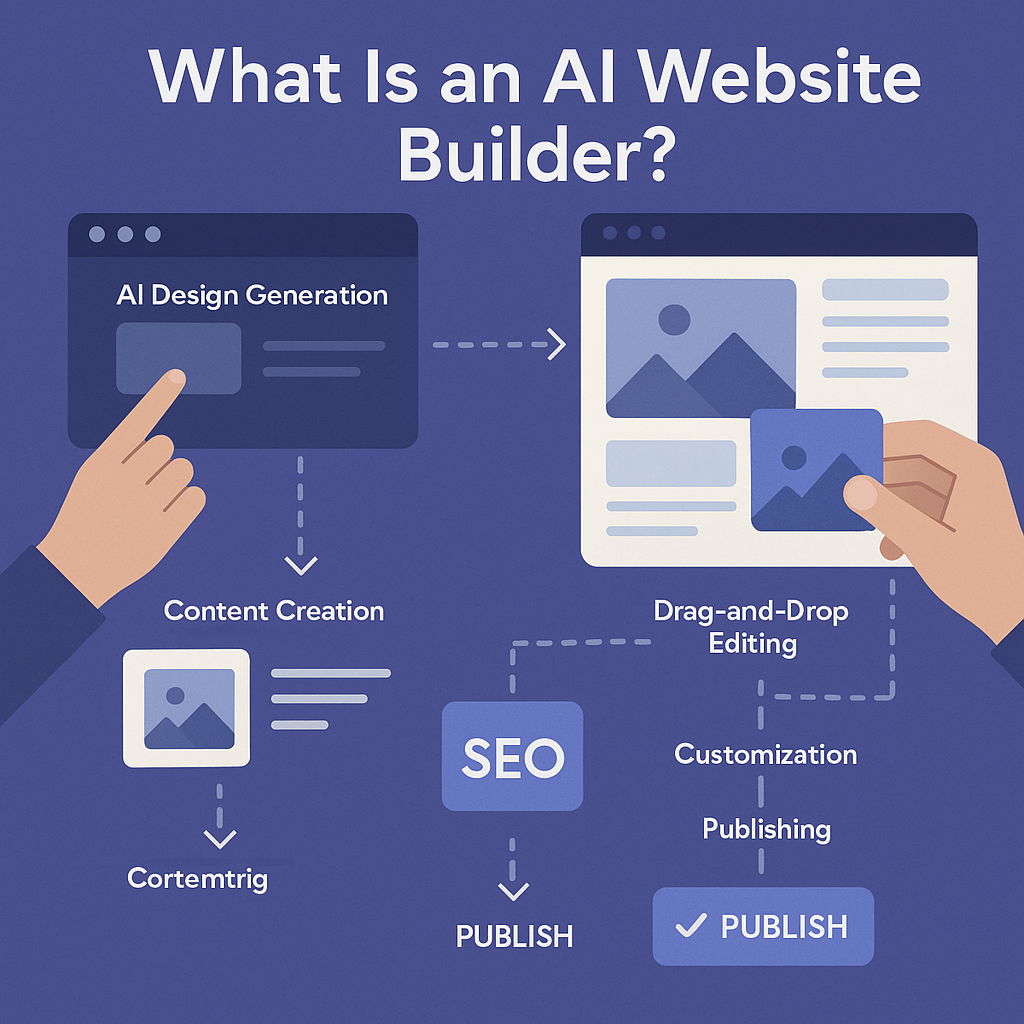
What Is an AI Website Builder?
An AI website builder is a platform that leverages artificial intelligence technologies to automate the creation of websites. Unlike traditional website builders that rely heavily on manual input for design and content, AI builders use algorithms to generate personalized layouts, suggest or create content, and optimize the site for search engines automatically.
At their core, these tools simplify the complex process of website development by handling multiple elements simultaneously:
- Design Automation: AI analyzes user preferences and industry standards to generate appealing and functional page layouts.
- Content Generation: Based on minimal user input, AI crafts text for various sections such as about pages, product descriptions, and blogs.
- SEO Setup: AI configures meta tags, keywords, and site structure to improve visibility on search engines.
Through this integration of automation and intelligence, AI website builders reduce the technical barrier and time investment traditionally associated with website creation.
How AI Website Builders Work
The operation of an AI website builder typically follows a sequence of steps designed to turn user input into a fully functional website:
1. User Input and Preferences
The process begins by gathering information from the user. This usually includes the type of website (e.g., business, portfolio, blog), industry sector, preferred styles or themes, and any specific features or goals. Some platforms may ask questions to understand the brand voice, target audience, or desired functionalities.
2. AI-Driven Design Generation
Using the input, the AI engine selects or creates a website layout. This involves choosing color schemes, font styles, navigation structures, and visual hierarchy to match the user’s preferences and current design best practices. The AI may also suggest images or icons that complement the theme.
3. Automated Content Creation
Next, the AI generates written content tailored to the website’s purpose. This includes headlines, paragraphs, product descriptions, and calls to action. The content aims to be clear, relevant, and engaging, often based on templates refined through machine learning.
4. Customization and User Refinement
Users typically have the option to customize the generated design and content. This can involve editing text, rearranging sections, uploading personal images, or adding new pages. Some AI builders incorporate drag-and-drop editors to make these adjustments intuitive.
5. Publishing and SEO Optimization
Finally, the AI handles search engine optimization by setting meta titles, descriptions, keywords, and site maps. Once everything is reviewed, the site can be published directly through the platform, often including hosting services.
Key Features to Look For
Drag-and-Drop Editing
A flexible editor allows users to adjust layouts easily without coding. Even after AI generates the initial design, drag-and-drop functionality enables personalized tweaks to fit specific needs.
AI Content Generation
Look for robust AI capabilities that can create diverse content types—such as blogs, product descriptions, and FAQs—tailored to your industry and style.
SEO Tools
Effective AI builders include built-in SEO features that automate optimization processes, helping your site rank better and attract organic traffic without requiring expert knowledge.
Integrations
Support for third-party tools like email marketing services, payment gateways, analytics platforms, and social media connectors enhances the website’s functionality and marketing potential.
Hosting
Many AI website builders provide integrated hosting, simplifying the publishing process and ensuring reliable site performance with minimal setup.
Analytics
Access to analytics dashboards lets users track visitor behavior, traffic sources, and conversion metrics, enabling informed decisions to improve site effectiveness.
Benefits and Limitations
Benefits
- Speed: AI can generate a functional website in minutes rather than days or weeks.
- Cost Savings: Reduces the need for hiring designers, developers, or content creators.
- Ease of Use: Designed for users with little to no technical background, lowering barriers to entry.
Limitations
- Customization Constraints: While AI offers templates and suggestions, the ability to deeply customize may be limited compared to manual design.
- Generic Structure: AI-generated content and layouts can sometimes feel formulaic or less unique.
- Dependence on AI: Relying heavily on AI may lead to challenges if the platform’s algorithms don’t align perfectly with the user’s vision or if advanced features are needed.
Who Should Use an AI Website Builder?
AI website builders are particularly well-suited for:
- Entrepreneurs: Individuals starting a new venture who need a quick and affordable way to establish an online presence.
- Small Business Owners: Businesses without dedicated IT or marketing teams can benefit from simplified website management.
- Bloggers and Creators: Those focused on content creation who want a hassle-free platform to showcase their work.
- Freelancers and Consultants: Professionals who require a portfolio or service site with minimal setup time.
However, organizations needing highly customized or complex websites may find AI builders less suitable and might prefer traditional development approaches.
Practical Checklist for Choosing an AI Website Builder
- Does it offer intuitive design automation with options for manual customization?
- Can the AI generate diverse and relevant content tailored to your industry?
- Are SEO tools integrated and easy to use?
- Does it support necessary integrations with marketing, payment, or analytics tools?
- Is hosting included, and what are the performance guarantees?
- Are analytics and visitor tracking available?
- What are the pricing structures, and do they fit your budget?
- Is customer support accessible and responsive?
Evaluating AI website builders against these criteria can help you select a platform that balances automation with control, enabling you to build an effective website aligned with your goals.
![Mastering AI-Powered Content Automation in WordPress: A Strategic Guide for Scalable Growth [2026-05-25 11:43:01 rdw72k]](https://getwpai.com/wp-content/uploads/2026/05/getwpai-20260525-114301.png)